
Scientists engineer bacteria to eat cancer tumors from the inside out
Engineered “hungry” bacteria may soon eat tumors from the inside out.
- Date:
- February 24, 2026
- Source:
- University of Waterloo
- Summary:
- Researchers are engineering bacteria to invade tumors and consume them from the inside. Because tumor cores lack oxygen, they’re the perfect breeding ground for these microbes. The team added a genetic tweak that helps the bacteria survive longer near oxygen-exposed edges — but only once enough of them are present to trigger the change. It’s a carefully programmed biological attack that could one day offer a new way to destroy cancer.
- Share:
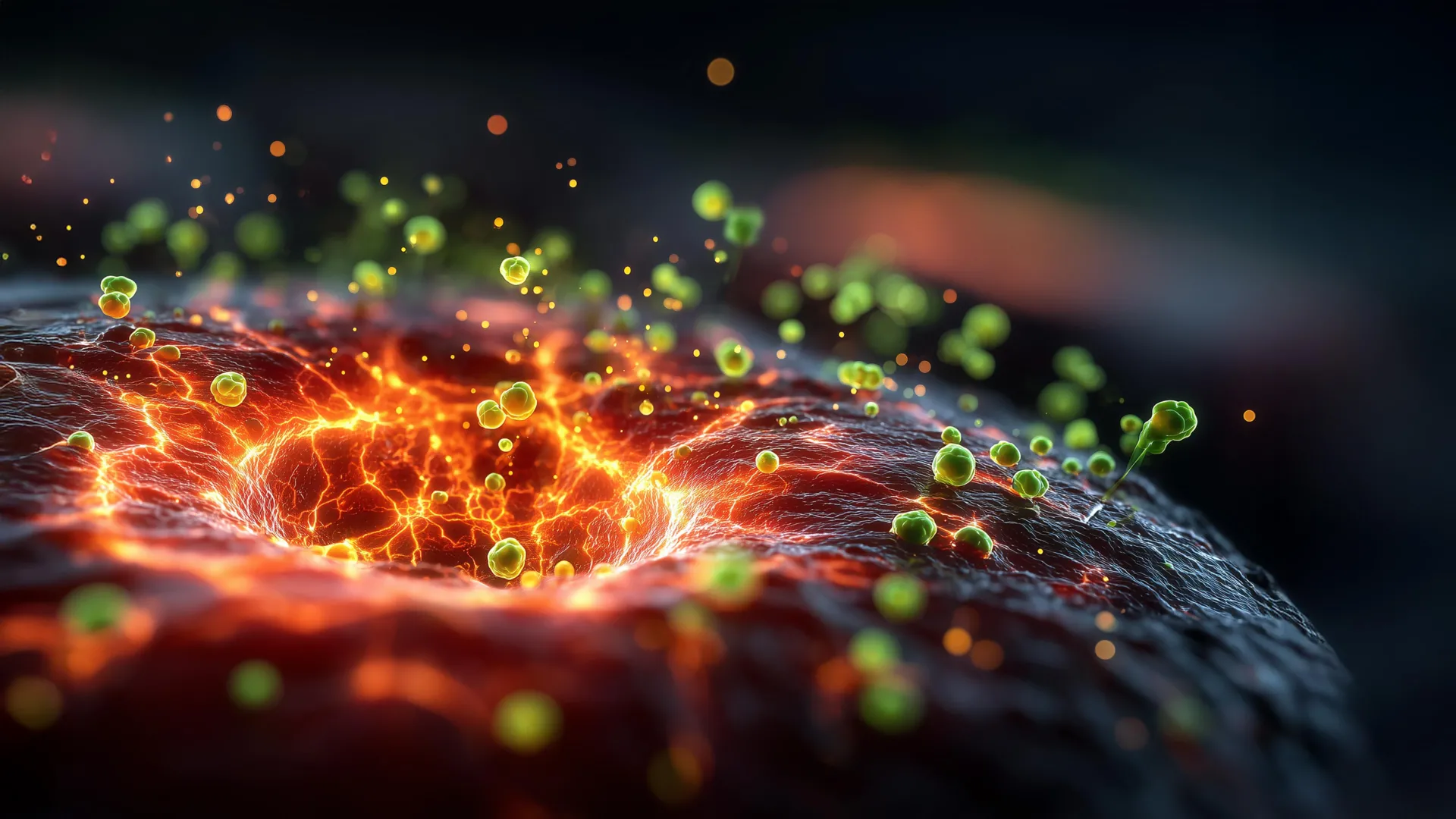
Scientists at the University of Waterloo are working on a new cancer treatment that uses specially engineered bacteria to consume tumors from the inside. The strategy relies on microbes that naturally thrive in oxygen-free environments, which makes the interior of many solid tumors an ideal target.
"Bacteria spores enter the tumor, finding an environment where there are lots of nutrients and no oxygen, which this organism prefers, and so it starts eating those nutrients and growing in size," said Dr. Marc Aucoin, a chemical engineering professor at Waterloo. "So, we are now colonizing that central space, and the bacterium is essentially ridding the body of the tumor."
At the center of this approach is Clostridium sporogenes, a bacterium commonly found in soil. It can survive only in places that contain absolutely no oxygen. The inner core of solid tumors is made up of dead cells and lacks oxygen, creating the perfect conditions for this microbe to multiply and spread.
Overcoming the Oxygen Barrier
There is a challenge, however. As the bacteria expand outward and reach areas of the tumor exposed to small amounts of oxygen, they begin to die off before fully eliminating the cancer.
To address this limitation, the team inserted a gene from a related bacterium that is more tolerant of oxygen. This modification allows the engineered microbes to survive longer near the tumor's outer regions.
The researchers also needed a way to control when that oxygen-tolerance feature turns on. Activating it too early could allow the bacteria to grow in oxygen-rich areas such as the bloodstream, which would be unsafe. To prevent that, they used a natural bacterial communication process called quorum sensing.
Quorum sensing relies on chemical signals released by bacteria. As their numbers increase, the signal grows stronger. Only after enough bacteria have accumulated inside a tumor does the signal reach a level that switches on the oxygen-resistant gene. This timing ensures the bacteria activate their survival mechanism only when it is needed.
Synthetic Biology and DNA Circuits
In an earlier study, the team showed that Clostridium sporogenes could be genetically altered to better withstand oxygen. In a follow-up experiment, they tested their quorum sensing design by programming bacteria to produce a green fluorescent protein, allowing them to confirm that the system activated at the intended moment.
"Using synthetic biology, we built something like an electrical circuit, but instead of wires we used pieces of DNA," said Dr. Brian Ingalls, a professor of applied mathematics at Waterloo. "Each piece has its job. When assembled correctly, they form a system that works in a predictable way."
The next step is to combine both the oxygen-tolerance gene and the quorum-sensing control system into a single bacterium and evaluate it against tumors in pre-clinical trials.
Collaboration Driving Cancer Innovation
This research began with work by PhD student Bahram Zargar under the supervision of Ingalls and Dr. Pu Chen, a retired professor of chemical engineering at Waterloo. The project highlights the university's focus on interdisciplinary health innovation, bringing together experts in engineering, mathematics, and life sciences to translate scientific discoveries into real-world medical solutions.
The Waterloo team is collaborating with the Center for Research on Environmental Microbiology (CREM Co Labs), a Toronto company co-founded by Dr. Zargar. The partnership also includes Dr. Sara Sadr, a former Waterloo doctoral student who played a leading role in advancing the research.
Story Source:
Materials provided by University of Waterloo. Note: Content may be edited for style and length.
Journal Reference:
- Sara Sadr, Bahram Zargar, Marc G. Aucoin, Brian Ingalls. Construction and Functional Characterization of a Heterologous Quorum Sensing Circuit in Clostridium sporogenes. ACS Synthetic Biology, 2025; 14 (12): 4857 DOI: 10.1021/acssynbio.5c00628
Cite This Page: