
The exact speed that makes an AI prosthetic arm feel like your own
For AI prosthetic arms, feeling human may matter more than moving fast.
- Date:
- February 13, 2026
- Source:
- Toyohashi University of Technology (TUT)
- Summary:
- A robotic arm that moves too quickly can feel creepy. One that moves too slowly feels awkward and unhelpful. In a VR study, researchers found that AI-powered prosthetic arms were best accepted when they moved at a natural, human-like speed—about one second per reach. That sweet spot boosted feelings of control, comfort, and even trust in the robot.
- Share:
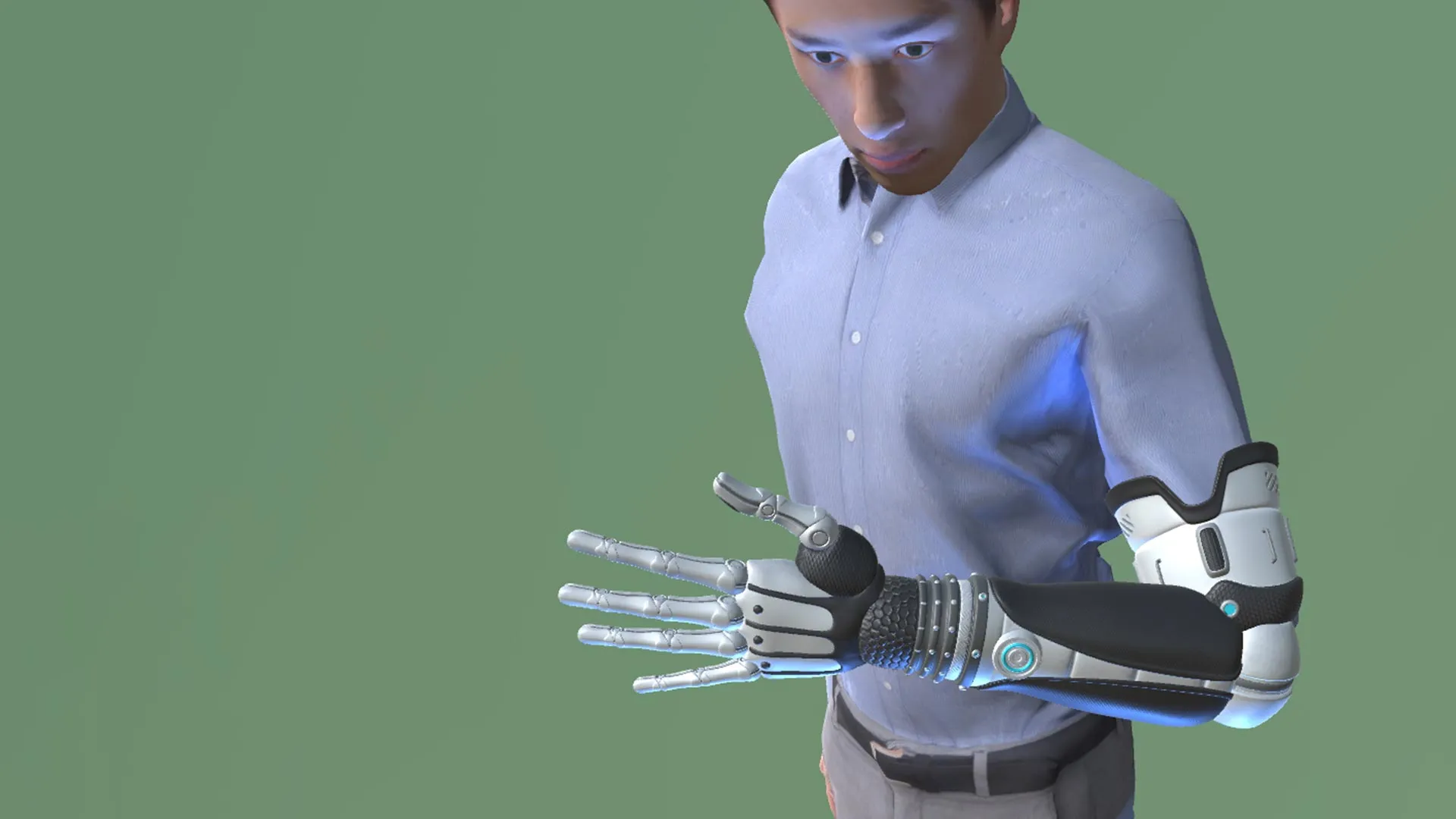
As artificial intelligence powered prosthetic arms become more common, understanding how people respond to them will be essential. Acceptance depends not only on how well these devices function, but also on how natural they feel. In this study, researchers used virtual reality to create the illusion that a participant's own arm had been replaced with a robotic prosthetic. They then tested how different movement speeds influenced embodiment, including body ownership, sense of agency, usability, and social impressions such as competence and discomfort.
The findings showed a clear pattern. When the prosthetic arm moved too quickly or too slowly, participants felt less connected to it and rated it as less usable. However, when the arm moved at a moderate pace similar to natural human reaching, taking about one second to complete the motion, participants reported the strongest sense that the arm felt like part of their own body.
From User Controlled Prosthetics to Autonomous AI
For individuals who lose a hand or arm, prosthetic limbs are critical tools for daily life. Much of the research in this field has focused on helping devices respond accurately to a user's intentions. This often involves detecting biosignals such as electromyography (EMG) and electroencephalography (EEG) and translating them into movement.
At the same time, rapid progress in machine learning and AI is making it possible for future prosthetics to assist users by moving on their own in certain situations. These autonomous or semi autonomous systems could anticipate needs and provide support automatically. Yet when a limb begins moving independently, it can feel "unsettling" or "not part of my body." That reaction presents a major challenge for widespread adoption.
Virtual Reality Study Tests Speed and Embodiment
Earlier research suggests that people are more comfortable with autonomous movement when they understand the goal behind it. Building on this idea, Harin Manujaya Hapuarachchi and colleagues (Hapuarachchi was a doctoral student at the time of the study and is now an Assistant Professor in the School of Informatics at Kochi University of Technology) explored whether movement speed plays a role in acceptance.
In a virtual reality environment, participants saw an avatar whose left forearm had been replaced with a prosthetic limb. They were asked to complete a reaching task while the virtual prosthetic arm moved on its own toward a target. The researchers adjusted the duration of each movement across six different speeds (125 ms to 4 s). After each trial, participants evaluated how much the arm felt like their own, how much control they felt, how usable it seemed (SUS), and their impressions of the robot using a standardized scale (RoSAS: competence, warmth, and discomfort).
The One Second Sweet Spot
The results were consistent and striking:
- At a moderate speed (movement duration of 1 s), ratings of body ownership, sense of agency, and usability were highest.
- In the fastest (125 ms) and slowest (4 s) conditions, those ratings dropped significantly.
- Participants viewed the arm as more competent at moderate to slightly faster speeds, while discomfort peaked in the fastest condition. Perceived warmth did not clearly depend on speed.
In short, simply making a prosthetic arm faster does not make it better. Matching the timing of natural human movement appears to be far more important for helping users feel that the device truly belongs to them.
Designing Human Like Robotic Body Augmentation
These insights suggest that future AI enabled prostheses should prioritize human compatible timing rather than speed alone. Designers may need to tune movement patterns so they align with what the brain expects from a natural limb.
The implications extend beyond prosthetic arms. Other technologies that function as extensions of the body, including supernumerary robotic limbs, exoskeletons, and wearable robots, could also benefit from movement that mirrors natural human rhythm.
Researchers also plan to explore how long term use changes perception. People often begin to experience frequently used tools as if they were part of their body. With continued daily use, even a fast and highly capable robotic limb may start to feel "normal," easier to operate, and more fully embodied.
Virtual reality plays a key role in this research. It allows scientists to test emerging prosthetic technologies and control systems in a safe and controlled setting before they are widely available. This approach makes it possible to evaluate psychological responses, user acceptance, and design considerations early in development.
This research was supported by JSPS KAKENHI (JP22KK0158), the Murata Science and Education Foundation, JST (JPMJFS121), and MEXT (202334Z302).
Story Source:
Materials provided by Toyohashi University of Technology (TUT). Note: Content may be edited for style and length.
Journal Reference:
- Harin Hapuarachchi, Yasuyuki Inoue, Hiroaki Shigemasu, Michiteru Kitazaki. Movement speed of an autonomous prosthetic limb shapes embodiment, usability and robotic social attributes in virtual reality. Scientific Reports, 2026; DOI: 10.1038/s41598-026-38977-8
Cite This Page: