
Nearly 70% of U.S. adults could now be classified as obese
A new obesity definition reveals that body fat location, not just body weight, could put nearly 7 in 10 U.S. adults at higher health risk.
- Date:
- December 31, 2025
- Source:
- Mass General Brigham
- Summary:
- A major update to how obesity is defined could push U.S. obesity rates to nearly 70%, according to a large new study. The change comes from adding waist and body fat measurements to BMI, capturing people who were previously considered healthy. Many of these newly included individuals face higher risks of diabetes and heart disease. The findings suggest that where fat is stored may be just as important as overall weight.
- Share:
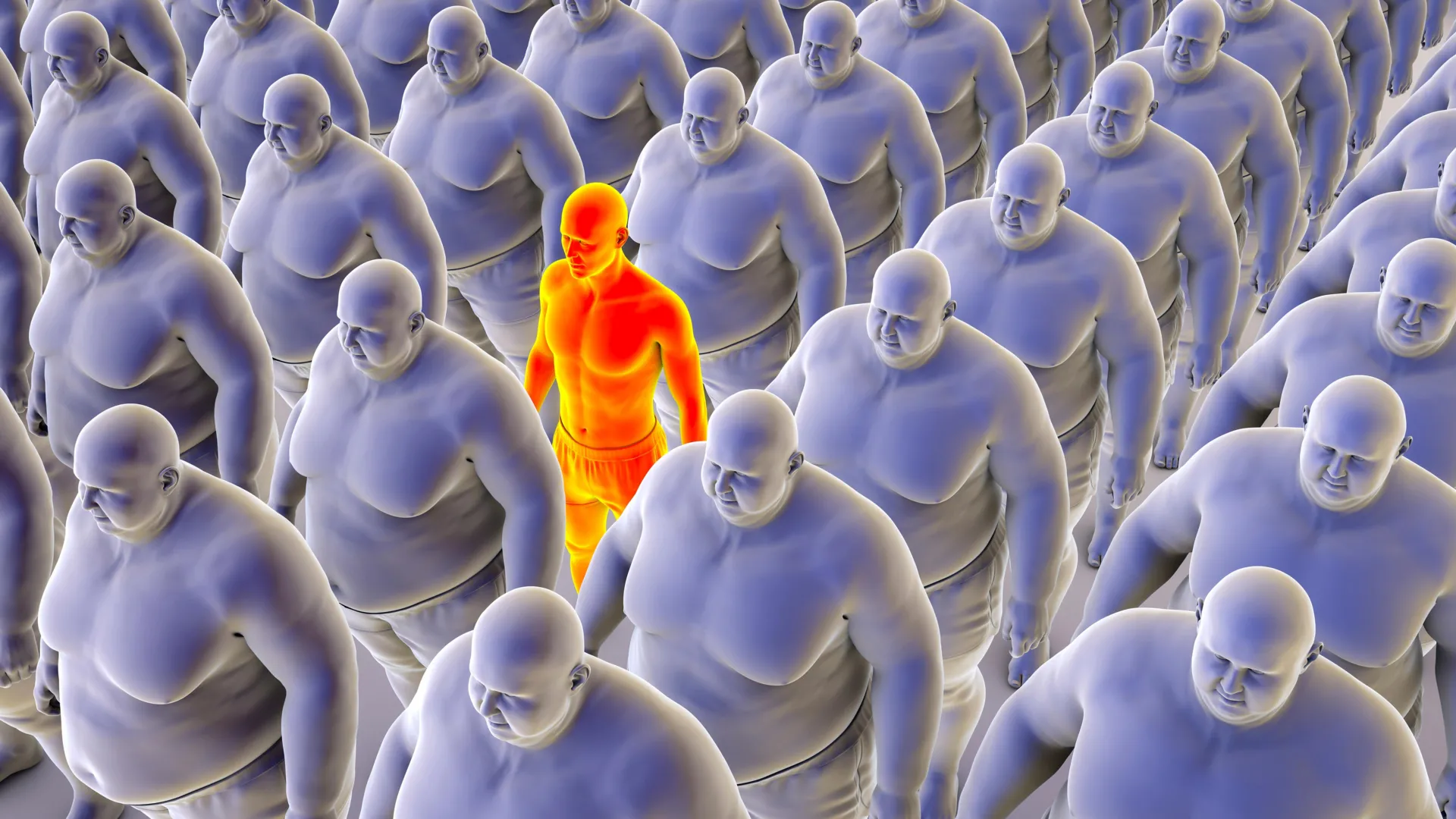
A newly proposed definition of obesity could significantly increase the number of Americans considered to have the condition. According to researchers at Mass General Brigham, applying updated criteria developed earlier this year by the Lancet Diabetes and Endocrinology Commission raises the estimated obesity rate in the United States from about 40 percent to nearly 70 percent. The study examined data from more than 300,000 people and found that the increase was especially pronounced among older adults. The findings also showed that many individuals newly classified under the updated definition face higher risks of serious health problems. The study was published in JAMA Network Open.
"We already thought we had an obesity epidemic, but this is astounding," said co-first author Lindsay Fourman, MD, an endocrinologist in the Metabolism Unit in the Endocrinology Division of the Mass General Brigham Department of Medicine. "With potentially 70 percent of the adult population now considered to have excess fat, we need to better understand what treatment approaches to prioritize."
Why BMI Alone May Miss Health Risks
For decades, obesity has primarily been defined using body mass index (BMI), a calculation based on height and weight. While BMI offers a simple estimate, it does not capture how fat is distributed throughout the body. Other anthropomorphic measures -- including waist circumference, waist-to-height ratio, and waist-to-hip ratio -- can provide additional insight by distinguishing fat mass from muscle and identifying abdominal fat linked to disease risk.
Under the updated framework, obesity is identified in two main ways. Individuals with a high BMI plus at least one elevated anthropometric measure are classified as having obesity, a category the authors call "BMI-plus-anthropometric obesity." People with a normal BMI can also be classified as having obesity if they have at least two elevated anthropometric measures, referred to as "anthropometric-only obesity." The guidelines further separate obesity into preclinical and clinical forms, with clinical obesity defined by obesity-related physical impairment or organ dysfunction. The new standards have already been endorsed by at least 76 organizations, including the American Heart Association and The Obesity Society.
Study Data Show a Sharp Rise in Obesity Rates
Researchers analyzed participants from the National Institutes of Health All of Us Research Program, which includes more than 300,000 Americans. Using the new definition, 68.6 percent of participants met the criteria for obesity, compared with 42.9 percent under the traditional BMI-based approach. The entire increase was attributed to individuals classified as having anthropometric-only obesity. Obesity rates differed across sex and race, but age showed the largest effect, with nearly 80 percent of adults over 70 meeting the new criteria.
Higher Health Risks in Newly Identified Groups
The study also found that people with anthropometric-only obesity, who would not have been labeled as having obesity under older standards, had higher rates of diabetes, cardiovascular disease, and mortality compared with individuals without obesity. Roughly half of all participants who met the new obesity definition were categorized as having clinical obesity. This percentage was only slightly lower among those with anthropometric-only obesity than among those with BMI-plus-anthropometric obesity.
"We have always recognized the limitations of BMI as a single marker for obesity because it doesn't take into account body fat distribution," said senior author Steven Grinspoon, MD, Chief of the Metabolism Unit in the Endocrinology Division of the Mass General Brigham Department of Medicine. "Seeing an increased risk of cardiovascular disease and diabetes in this new group of people with obesity, who were not considered to have obesity before, brings up interesting questions about obesity medications and other therapeutics."
What This Means for Treatment and Future Research
The researchers note that additional studies are needed to better understand why anthropometric-only obesity develops and which treatments may be most effective. The team has previously developed a therapy aimed at reducing waist circumference and plans to evaluate how different treatment strategies might benefit this newly defined group.
"Identifying excess body fat is very important as we're finding that even people with a normal BMI but with abdominal fat accumulation are at increased health risk," Fourman said. "Body composition matters -- it's not just pounds on a scale."
Authorship: In addition to Fourman and Grinspoon, Mass General Brigham authors include Aya Awwad, Camille A. Dash, Julia E. Johnson, Allison K. Thistle, Nikhita Chahal, Sara L. Stockman, Mabel Toribio, Chika Anekwe, and Arijeet K. Gattu. Additional authors include Alba Gutiérrez-Sacristán.
Disclosures: Fourman serves as a consultant to Theratechnologies and Chiesi Farmaceutici and receives grant funding to her institution from Chiesi Farmaceutici outside of this work. Grinspoon serves as a consultant to Marathon Assets Management and Exavir Therapeutics and receives grant funding to his institution from Kowa Pharmaceuticals, Gilead Sciences, and Viiv Healthcare, unrelated to this project. For the remaining authors, no conflicts were declared.
Funding: This work was supported by the National Institutes of Health (grants K23HD100266, 1R01AG087809, T32DK007028, K23HL147799, 1R01HL173028, and P30DK040561) as well as the American Heart Association-Harold Amos Medical Research Faculty Development Program, supported by the Robert Wood Johnson Foundation, and the Robert A. Winn Excellence in Clinical Trials Award Program from the Bristol Meyers Squibb Foundation. The funding organizations played no role in the design and conduct of the study, collection, management, analysis, and interpretation of the data; preparation, review, or approval of the manuscript; and decision to submit the manuscript for publication.
Story Source:
Materials provided by Mass General Brigham. Note: Content may be edited for style and length.
Journal Reference:
- Lindsay T. Fourman, Aya Awwad, Alba Gutiérrez-Sacristán, Camille A. Dash, Julia E. Johnson, Allison K. Thistle, Nikhita Chahal, Sara L. Stockman, Mabel Toribio, Chika Anekwe, Arijeet K. Gattu, Steven K. Grinspoon. Implications of a New Obesity Definition Among the All of Us Cohort. JAMA Network Open, 2025; 8 (10): e2537619 DOI: 10.1001/jamanetworkopen.2025.37619
Cite This Page: