
A long-nosed chameleon hid its true identity for 150 years
- Date:
- December 13, 2025
- Source:
- Staatliche Naturwissenschaftliche Sammlungen Bayerns
- Summary:
- Scientists have discovered that Madagascar’s iconic Pinocchio chameleon is actually a distinct species now named Calumma pinocchio. DNA from both modern samples and centuries-old museum specimens also exposed another hidden species, Calumma hofreiteri. The study shows that the chameleons’ elongated snouts evolve surprisingly quickly, likely influenced by female mate choice. These findings highlight Madagascar as a hotspot of rapidly diversifying reptile life.
- Share:
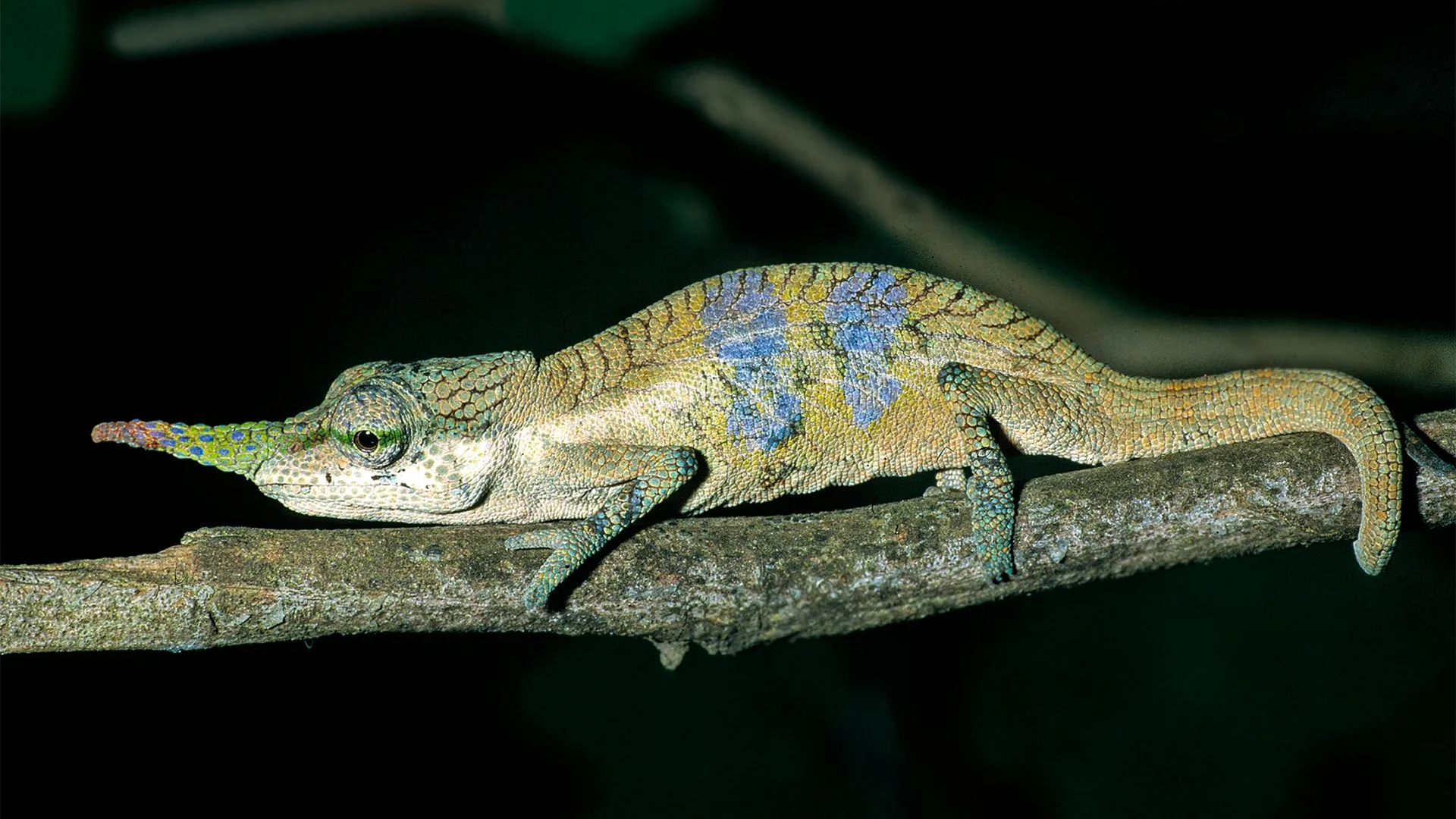
Madagascar is widely recognized for its extraordinary variety of chameleons. More than 40% of all species known worldwide live on this island off the East African coast. Among them is the so called Pinocchio chameleon, a reptile described for nearly 150 years. This animal is part of the Calumma gallus species complex, a group in which males are known for their elongated nasal appendages. Until recently, the length and shape of this distinctive snout were the primary traits used to identify the species.
Genetic and anatomical studies now show that the reptile long referred to as the Pinocchio chameleon is not the species scientists thought it was. According to the research team, it represents a completely new species, which they named Calumma pinocchio so that its scientific and common names align.
Additional Hidden Species Within Nose Chameleons
By analyzing DNA from historically collected specimens, the researchers uncovered even more complexity within the group. Their work revealed a second previously unrecognized species, Calumma hofreiteri, which had been classified for years as Calumma nasutum because of similarities in the nasal appendage and other visible traits.
"The genetic analyses are conclusive: the nose chameleons have virtually fooled previous research," explains first author Dr. Frank Glaw from the Bavarian State Collections of Natural History (SNSB). "Our study also revealed that the nasal appendages can change quickly in terms of length, shape, and color. Their evolution is possibly driven by the respective preferences of females in mate selection."
Using Museomics to Identify Species From the Past
To update the classification of nose chameleons, the team applied a museomics approach, a method that allows scientists to extract DNA from long-preserved museum specimens. The oldest sample in the project was a chameleon collected in 1836. "The study shows the great potential of the new museomics methods to correctly identify historically collected specimens especially in species complexes," notes Prof. Miguel Vences from the Technical University of Braunschweig.
With these two newly described species, Madagascar is now known to host exactly 100 chameleon species, contributing to a global total of 236.
Story Source:
Materials provided by Staatliche Naturwissenschaftliche Sammlungen Bayerns. Note: Content may be edited for style and length.
Journal Reference:
- Frank Glaw, Stefanie Agne, David Prötzel, Philip-Sebastian Gehring, Jörn Köhler, Michaela Preick, Fanomezana M. Ratsoavina, Nicolas Straube, Katharina Wollenberg Valero, Angelica Crottini, Miguel Vences. Towards a revision of the Malagasy chameleons of the Calumma gallus complex: Redefinition of Calumma nasutum based on a museomics approach and descriptions of two new species. Salamandra, 2025 [abstract]
Cite This Page: