
Scientists find a surprising genetic twist behind octopus intelligence
Researchers uncovered an ancient DNA reshuffling that may help explain how octopuses, squid, and cuttlefish evolved their extraordinary intelligence.
- Date:
- October 12, 2026
- Source:
- University of Vienna
- Summary:
- The remarkable intelligence of octopuses, squid, and cuttlefish may trace back to an ancient reshuffling of their DNA that created new connections between genes. Scientists discovered that these changes in the genome's 3D structure may have helped drive the evolution of their unusually complex nervous systems.
- Share:
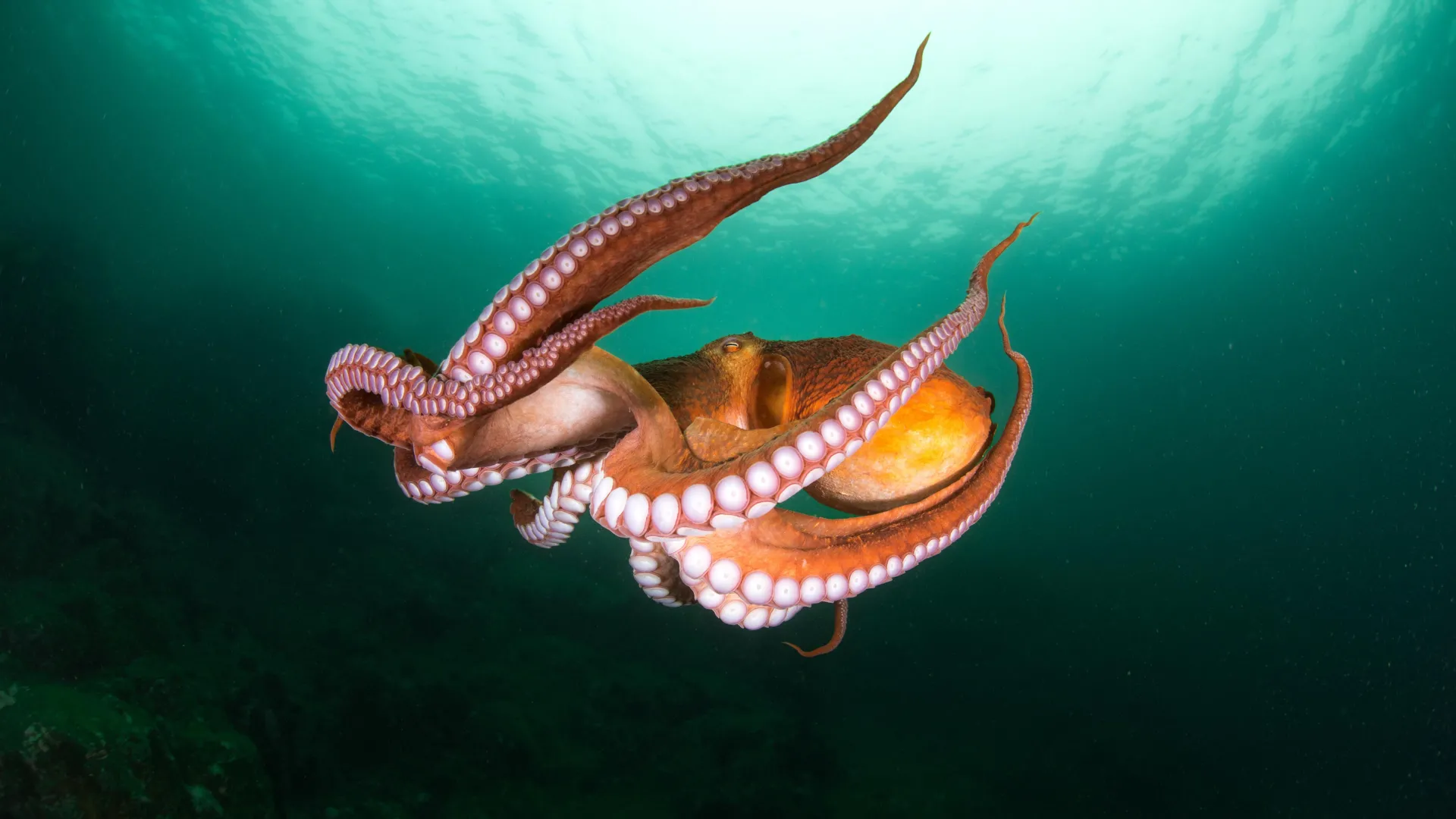
Octopuses, squid, and cuttlefish possess some of the most sophisticated nervous systems in the animal kingdom, giving them remarkable abilities such as solving problems and rapidly changing their appearance to blend into their surroundings. But how did these extraordinary capabilities evolve? Scientists have uncovered a surprising clue that may lie not in the genes themselves, but in the way DNA is folded and arranged inside cells.
Researchers at the University of Vienna discovered that a massive reorganization of DNA hundreds of millions of years ago brought previously separated genetic regions into contact. These newly formed connections changed how genes could interact and be controlled, potentially helping drive the evolution of the unusually complex nervous systems found in these animals, which are collectively known as coleoid cephalopods.
The findings, published in Nature Communications, suggest that the physical structure of DNA may play a much more active role in evolution than scientists once thought.
How the 3D Structure of DNA Influences Evolution
To investigate this possibility, the research team reconstructed the three-dimensional organization of the genome in octopuses, squid, and cuttlefish. They then compared the arrangement of DNA with patterns of gene activity to understand how changes in genome structure might influence biological complexity.
"The genome isn't just a sequence of genes. It's folded into a complex three-dimensional structure," said lead author Dr. Thea Rogers. "Understanding how that structure evolves is becoming increasingly important for understanding how new forms of biological complexity arise."
Although DNA is often pictured as a long, twisted ladder, it does not simply stretch out inside a cell. Instead, it folds into an intricate three-dimensional arrangement, allowing sections that are far apart along the DNA sequence to come into close physical contact.
These connections matter because they can influence which genes are activated, when they are used, and how strongly they function. Changes in the way DNA folds can therefore alter gene activity without necessarily changing the underlying genetic instructions.
An Ancient DNA Reshuffling Created New Genetic Connections
The researchers found evidence that cephalopod genomes underwent an extensive period of reorganization hundreds of millions of years ago. During this evolutionary upheaval, large sections of genetic material were rearranged, bringing regions of chromosomes that had previously been separated into close proximity.
This reshuffling created opportunities for DNA regions to interact in ways that had not previously been possible. Once these connections formed, they could influence each other's activity, gradually establishing more elaborate networks of genetic regulation.
Over evolutionary time, the interactions could become increasingly interconnected and difficult to separate, creating a process the scientists describe as "regulatory entanglement."
This mechanism offers a possible explanation for how evolution can produce new biological features without disrupting the essential functions organisms need to survive. By establishing new connections among existing genetic elements, the genome may develop different patterns of gene activity while keeping crucial biological systems intact.
Stable DNA Structures and Flexible Genetic Loops
One of the study's most revealing findings was that different parts of the genome responded very differently to evolutionary reorganization.
The researchers discovered that large structural regions called chromatin domains remained remarkably stable over long periods of evolutionary history. These domains help organize DNA into broad sections within the cell, and their persistence suggests that some features of genome architecture are strongly conserved.
Smaller structures known as chromatin loops, however, told a different story.
These loops form when distant sections of DNA are brought together in three-dimensional space. Unlike the relatively stable chromatin domains, the loops showed substantial differences between cephalopod species, between tissues, and across stages of development.
Particularly intriguing was their location. Many of these flexible DNA connections appeared near genes associated with important cephalopod characteristics, including the development and function of the nervous system.
This pattern suggests that smaller, more adaptable structures within the genome may be especially responsive to major genetic rearrangements. By changing which regions of DNA can communicate, these flexible connections could help generate new patterns of gene activity and contribute to the evolution of complex traits.
A New Clue to the Evolution of Octopus Intelligence
The discovery challenges a traditional view of genome architecture as something that primarily changes in response to evolution. Instead, the findings suggest that the physical organization of DNA can itself influence how evolutionary changes unfold.
In octopuses, squid, and cuttlefish, ancient rearrangements of the genome may have helped establish new regulatory networks that contributed to the development of their exceptionally sophisticated nervous systems.
The results do not establish that these DNA changes directly caused the evolution of cephalopod intelligence. However, they reveal a potential mechanism through which large genetic rearrangements could create new biological possibilities while preserving essential functions.
More broadly, the research points to an often overlooked dimension of evolution. The emergence of extraordinary traits may depend not only on which genes an organism inherits, but also on how those genes are physically arranged and connected within the cell.
Story Source:
Materials provided by University of Vienna. Note: Content may be edited for style and length.
Journal Reference:
- Thea F. Rogers, Jessica Stock, Natalie Grace Schulz, Gözde Yalçin, Simone Rencken, Anton Weissenbacher, Tereza Clarence, Darrin T. Schultz, Clifton W. Ragsdale, Caroline B. Albertin, Oleg Simakov. Genome reorganisation and expansion shape 3D genome architecture and define a distinct regulatory landscape in coleoid cephalopods. Nature Communications, 2026; 17 (1) DOI: 10.1038/s41467-026-77625-7
Cite This Page: