
Queen bees have a disturbing way to survive pesticides
Honeybee queens may survive pesticide exposure by passing the toxic burden into their eggs, a hidden defense that could come at a cost to the colony.
- Date:
- August 21, 2026
- Source:
- University of California - Davis
- Summary:
- Honeybee queens exposed to pesticides can shift some of the contamination into their eggs, revealing a previously unknown survival strategy. The process may protect the queen while putting developing offspring, and potentially the entire colony, at risk.
- Share:
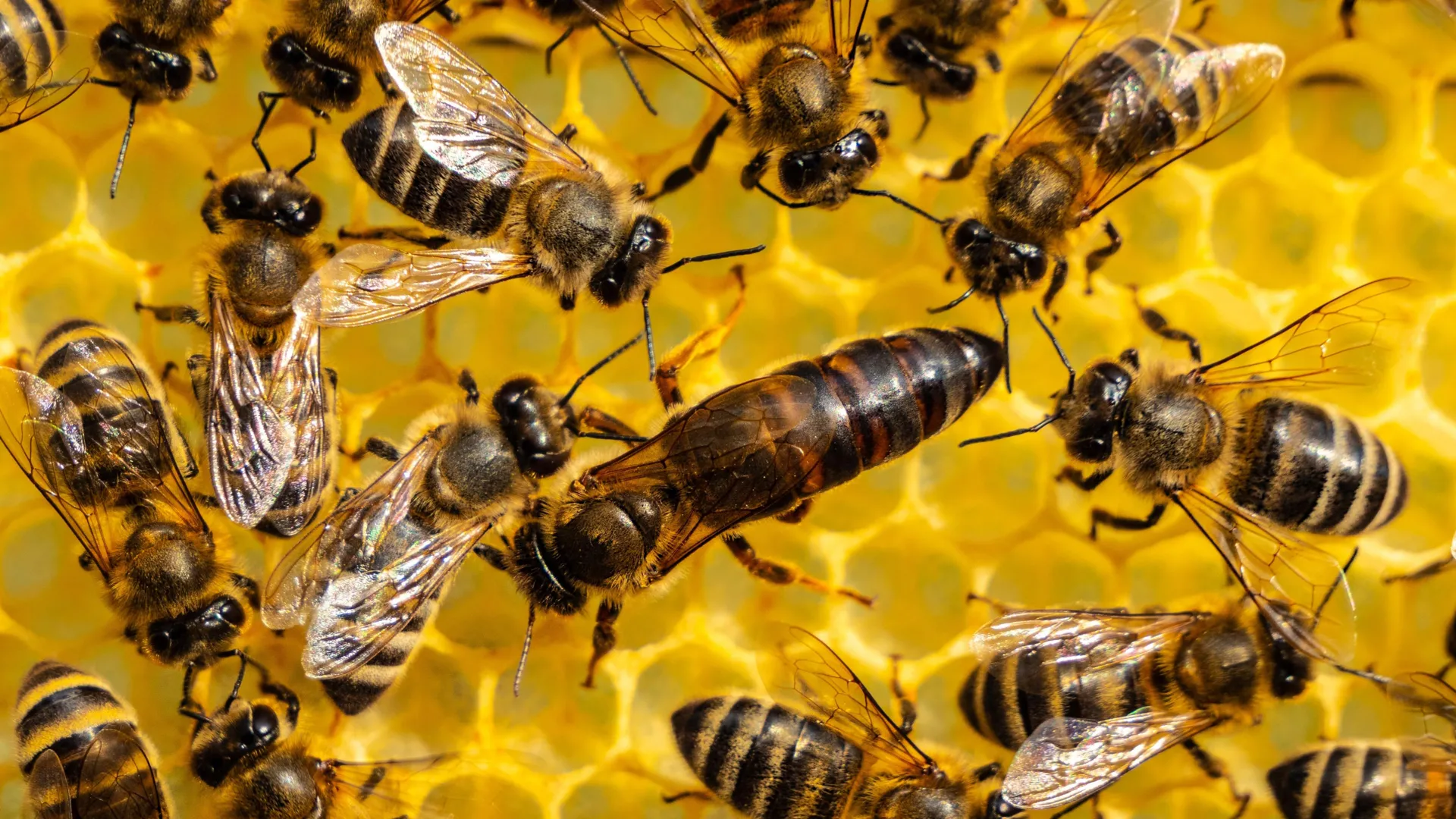
Worker bees normally serve as a colony's first line of defense against contamination, filtering harmful substances before they can spread through the hive. But new research shows that queen bees also have a defense of their own.
When honeybee queens are exposed to pesticides over time, some of those chemicals can accumulate in their bodies and then be transferred into their eggs. Researchers call this process maternal offloading.
The findings, published in Current Biology, provide the first evidence in honeybees of how far a queen may go to reduce her own chemical burden. The research was led by the University of California, Davis.
"In order to protect herself, the queen bee offloads these chemicals into her eggs to get rid of them," said Sascha Nicklisch, the paper's senior author and an associate professor in the Department of Environmental Toxicology. "No one has shown this in honeybees before."
Pesticides Can Build Up Inside the Hive
The results suggest that pesticides may continue accumulating in a colony even after exposure begins, especially once worker bees are no longer able to remove contaminants as effectively. That could have implications for beekeepers, growers and integrated-pest-management planners, particularly during periods when bees are actively foraging or colonies are expanding.
The study was carried out in collaboration with Lawrence Livermore National Laboratory, or LLNL, and the U.S. Department of Agriculture's Agricultural Research Service, or USDA-ARS.
"When pesticides accumulate to the extent that the queen bee has eggs that are so loaded they may no longer develop properly, there could be a tipping point," Nicklisch said. "There may be a slow creeping effect of chemical accumulation that will contribute to delayed colony collapse."
Most previous toxicology research involving honeybees has centered on worker bees. This study instead followed where chemicals ended up throughout the colony and examined their effects on the queen, her ovaries, her eggs, and the wax. Worker bees normally feed and care for both queens and developing larvae.
Worker Bee Protection Has Limits
Scientists have long thought that worker bees help shield queens from contamination by filtering harmful substances out of the food they provide. The new findings indicate that this protection may only work up to a point, said Angela Encerrado-Manriquez, the paper's lead author and a recent Ph.D. graduate from UC Davis.
"In our study, pesticides began to accumulate in queens over time, suggesting that worker filtration capacity can be overwhelmed," Encerrado-Manriquez said. "When this happens, queens have their own defense. Maternal offloading allows them to shunt the toxic burden to their eggs."
To study the process, researchers built so-called "nanocolonies," small experimental systems designed to reproduce key functions inside a hive. Each consisted of a conical plastic container with a netted bottom and held one queen along with 60 worker bees.
The bees received pollen, water, and food contaminated with the pesticide methyl parathion. The pesticide was tagged with a low-level radioactive marker so researchers could track where it moved.
On the first day, worker bees filtered out 95% of the pesticide and transferred it into the honeycomb. By day 10, however, that figure had dropped to 86%.
Tracking Pesticides at Extremely Low Levels
The project combined the USDA's expertise in honeybee biology and experimental design with specialized technology at LLNL. Researchers there used biological accelerator spectrometry, or BioAMS, to detect radioactive markers at extremely small concentrations.
"With BioAMS, we can trace very low levels of a pesticide," said Bruce Buchholz, an LLNL scientist and author on the paper. "The pesticide concentrations we used were not lethal and were environmentally relevant to that seen in nature."
Honeybee queens can produce 1,500 to 2,000 eggs every day, supplying colonies with the workers needed to keep the hive functioning. Honeybees also pollinate about one-third of the world's food crops, making colony losses a concern for both agricultural productivity and food security.
"The queen is the only member of the hive who can lay eggs that become the next generation of workers," Nicklisch said. "She keeps the colony alive, so understanding how pesticides can affect queen bees and also her offspring is important."
Questions About Long-Term Colony Effects
Researchers still do not know how long queens can continue transferring contaminants into their eggs, what the long-term consequences may be for the colony, or whether the process differs depending on the pesticide involved. Those questions are targets for future research.
Julia Fine and Eliza Litsey with USDA-ARS and David Baliu-Rodriguez, Sean Leonard and Bruce Buchholz at LLNL contributed to the research.
The USDA's National Institute of Food and Agriculture and Non-Assistance Cooperative Agreement program supported the research, as did the PAm-Costco USA Scholarship program and the University of California National Laboratory Fees Research Program. The work at LLNL is under a U.S. Department of Energy contract.
Story Source:
Materials provided by University of California - Davis. Note: Content may be edited for style and length.
Journal Reference:
- Angela M. Encerrado-Manriquez, Julia D. Fine, Eliza Litsey, David Baliu-Rodriguez, Sean Patrick Leonard, Bruce A. Buchholz, Sascha C.T. Nicklisch. Queen bees offload pesticide burden to eggs when social buffering is overwhelmed. Current Biology, 2026; 36 (15): 3734 DOI: 10.1016/j.cub.2026.06.022
Cite This Page: