
New research shows emotional expressions work differently in autism
Autistic and non-autistic faces speak different emotional languages—and misunderstanding goes both ways.
- Date:
- January 19, 2026
- Source:
- University of Birmingham
- Summary:
- Researchers found that autistic and non-autistic people move their faces differently when expressing emotions like anger, happiness, and sadness. Autistic participants tended to rely on different facial features and produced more varied expressions, which can look unfamiliar to non-autistic observers. The study suggests emotional misunderstandings are a two-way street, not a one-sided deficit.
- Share:
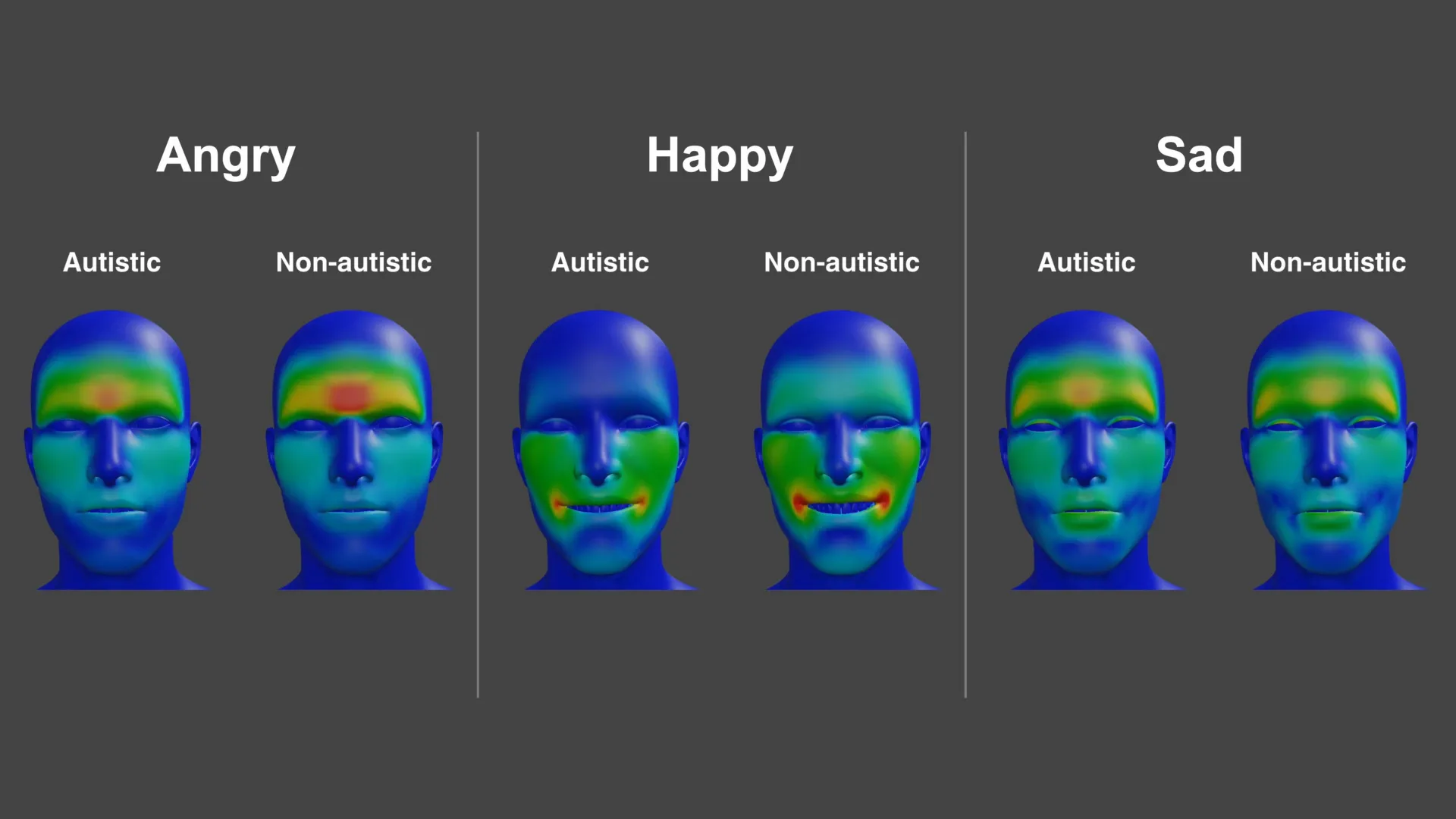
A new study suggests that autistic and non-autistic people use their faces to show emotions in different ways. These differences may help explain why emotional expressions are sometimes misunderstood between the two groups.
Researchers at the University of Birmingham carried out a large-scale project to map facial expressions linked to basic emotions such as anger, happiness and sadness. Using advanced facial motion tracking, the team recorded more than 265 million data points, creating one of the most detailed libraries of emotional facial movements to date.
The research was published in the journal Autism Research.
How the Study Was Conducted
The study included 25 autistic adults and 26 non-autistic adults. Together, participants produced nearly 5000 facial expressions. Each person was asked to display anger, happiness and sadness in two settings: while matching facial movements to sounds and while speaking.
Clear differences emerged between the two groups. Autistic participants also showed a wider range of unique expressions. Specific patterns stood out:
- For anger, autistic participants relied more heavily on mouth movements and used their eyebrows less than non-autistic participants;
- For happiness, autistic participants displayed a more subtle smile that did not "reach the eyes"; and
- For sadness, autistic participants created a downturned expression by lifting the upper lip more than their non-autistic peers.
The Role of Alexithymia in Emotional Expression
The researchers also examined the influence of alexithymia -- a 'sub-clinical' condition commonly found in autism that involves difficulty identifying and describing one's own emotions. People with higher levels of alexithymia showed less clearly defined facial expressions for anger and happiness, which made those emotions appear more ambiguous.
Why Emotional Misunderstandings Happen
Dr. Connor Keating, who led the research at the University of Birmingham and is now based in the Department of Experimental Psychology at the University of Oxford, explained that the differences go beyond how expressions look. "Our findings suggest autistic and non-autistic people differ not only in the appearance of facial expressions, but also in how smoothly these expressions are formed. These mismatches in facial expressions may help to explain why autistic people struggle to recognize non-autistic expressions and vice versa."
Emotional Expression as a Two-Way Challenge
Professor Jennifer Cook, the study's senior author at the University of Birmingham, emphasized that these differences should not be viewed as a deficit. "Autistic and non-autistic people may express emotions in ways that are different but equally meaningful -- almost like speaking different languages. What has sometimes been interpreted as difficulties for autistic people might instead reflect a two-way challenge in understanding each other's expressions. We are currently investigating this idea, so watch this space for updates."
Funding and Support
The research was supported by the Medical Research Council (MRC, United Kingdom) and the European Union's Horizon 2020 Research and Innovation Programme.
Story Source:
Materials provided by University of Birmingham. Note: Content may be edited for style and length.
Journal Reference:
- Connor T. Keating, Sophie Sowden‐Carvalho, Holly O′Donoghue, Jennifer L. Cook. Mismatching Expressions: Spatiotemporal and Kinematic Differences in Autistic and Non‐Autistic Facial Expressions. Autism Research, 2026; DOI: 10.1002/aur.70157
Cite This Page: