
This fish-inspired filter removes over 99% of microplastics
A fish-inspired washing machine filter could stop over 99% of microplastics from escaping into the environment.
- Date:
- December 22, 2025
- Source:
- University of Bonn
- Summary:
- Washing machines release massive amounts of microplastics into the environment, mostly from worn clothing fibers. Researchers at the University of Bonn have developed a new, fish-inspired filter that removes over 99% of these particles without clogging. The design mimics the funnel-shaped gill system used by filter-feeding fish, allowing fibers to roll away instead of blocking the filter. The low-cost, patent-pending solution could soon be built directly into future washing machines.
- Share:
Wastewater from washing machines is widely seen as a major source of microplastics -- tiny plastic particles suspected of harming both people and animals. To help reduce that pollution, researchers at the University of Bonn have created a new filter based on a natural model: the gill arch system in fish. In early tests, the patent-pending device removed more than 99 percent of plastic fibers from washing machine wastewater. The findings were published in the journal npj Emerging Contaminants.
A washing machine used by a four-person household can generate up to 500 grams of microplastics each year, largely due to fibers wearing off textiles during washing. That makes everyday laundry one of the most important sources of these particles. Today, much of that material ends up in the sewage sludge produced at wastewater treatment plants. Because this sludge is often applied as fertilizer, the fibers can ultimately be spread onto fields.
Why existing washing machine filters fall short
Because of the scale of the problem, many manufacturers have been looking for ways to remove microplastics from wash water before it reaches the environment. "The filter systems available so far, however, have various disadvantages," explains Dr. Leandra Hamann from the Institute for Organismic Biology at the University of Bonn. "Some of them quickly become clogged, others do not offer adequate filtration."
Hamann, working with her doctoral supervisor Dr. Alexander Blanke and other colleagues, turned to biology for ideas. The team focused on fish that act as expert natural filters -- the result of hundreds of millions of years of evolution.
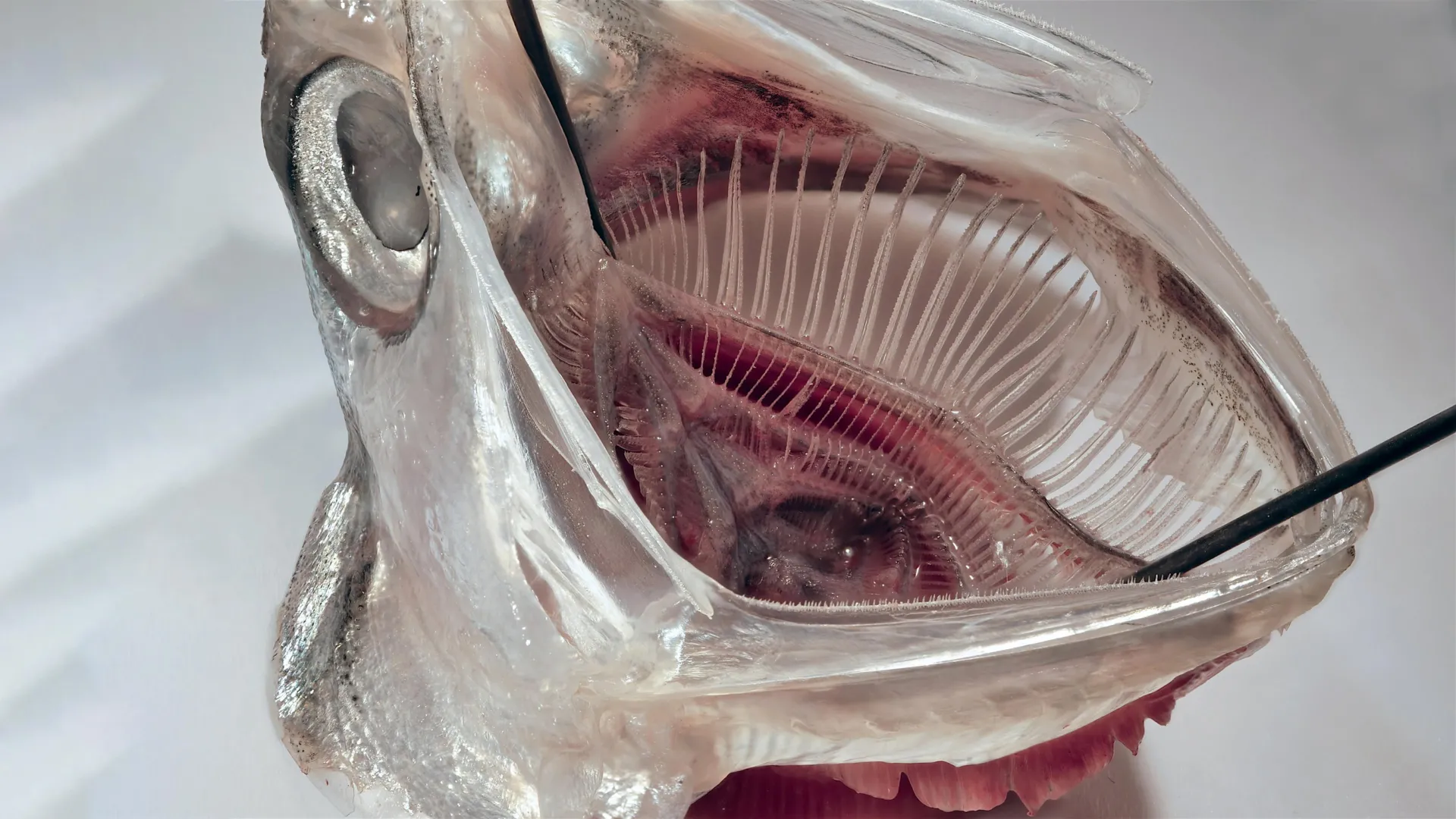
Some fish feed by filtering water, including mackerel, sardines, and anchovies. They swim with open mouths and capture plankton using their gill arch system. "We took a closer look at the construction of this system and used it as the model for developing a filter that can be used in washing machines," says Blanke, who is a member of the transdisciplinary research areas "Life & Health" and "Sustainable Futures" at the University of Bonn.
How fish gills inspired a self-cleaning filter design
Over time, these fish evolved a strategy similar to cross-flow filtration. Their gill arch system forms a funnel that is widest at the mouth and narrows toward the gullet. The funnel's walls are formed by branchial arches, which include comb-like structures. Those structures are covered in tiny teeth, creating a mesh stretched across the arches.
"During food intake, the water flows through the permeable funnel wall, is filtered, and the particle-free water is then released back into the environment via the gills," explains Blanke. "However, the plankton is too big for this; it is held back by the natural sieve structure. Thanks to the funnel shape, it then rolls towards the gullet, where it is collected until the fish swallows, which empties and cleans the system."
That same idea helps prevent clogs. Instead of slamming directly into a flat barrier, particles move along the surface and are guided onward toward the gullet. The approach is also highly efficient, since it removes almost all plankton from the water. A washing machine microplastic filter needs both strengths: strong capture and resistance to blockage. To build a version for laundry, the researchers recreated the gill arch system and tested different mesh sizes and funnel opening angles.
Test results, manufacturing costs, and microplastic removal
"We have thus found a combination of parameters that enable our filter to separate more than 99 percent of the microplastics out of the water but not become blocked," says Hamann. The team reached that result by combining lab experiments with computer simulations. Because the nature-based design avoids complicated moving parts, it should be inexpensive to produce.
Captured microplastics collect at the filter outlet and are suctioned away several times per minute. Hamann, who has since moved to the University of Alberta in Edmonton, Canada, says the collected material could be pressed inside the machine to squeeze out remaining water. The resulting plastic pellet could then be removed every few dozen washes and thrown away with general waste.
Patents, industry hopes, and health concerns
The University of Bonn team and the Fraunhofer Institute for Environmental, Safety, and Energy Technology UMSICHT have already applied for a patent in Germany, and EU-wide patenting is now in progress. The researchers hope manufacturers will refine the design and build it into future washing machines. That could reduce the spread of textile-based microplastics, at least to some extent. The need is pressing: analyses suggest these particles may cause serious health harm. They have already been detected in breast milk and in the placenta -- and even in the brain.
Participating institutions and funding
In addition to the University of Bonn, the Fraunhofer Institute for Environmental, Safety, and Energy Technology UMSICHT contributed to the study. Funding came from the Federal Ministry of Research, Technology and Space (BMFTR) and the European Research Council (ERC). Support for protecting and marketing the invention is being provided by the Transfer Center enaCom at the University of Bonn in close cooperation with PROvendis GmbH, a service provider for the NRW university network for knowledge and technology transfer "innovation2business.nrw."
Story Source:
Materials provided by University of Bonn. Note: Content may be edited for style and length.
Journal Reference:
- Leandra Hamann, Christian Reuß, Hendrik Herzog, Kristina Schreiber, Christian Geitner, Alexander Blanke. A self-cleaning, bio-inspired high retention filter for a major entry path of microplastics. npj Emerging Contaminants, 2025; 1 (1) DOI: 10.1038/s44454-025-00020-2
Cite This Page: