
3.3 billion-year-old crystals reveal a shockingly active early Earth
New evidence reveals a surprisingly dynamic Hadean Earth already forging continents and recycling crust.
- Date:
- December 4, 2025
- Source:
- GFZ Helmholtz-Zentrum für Geoforschung
- Summary:
- Fresh evidence suggests early Earth wasn’t locked under a rigid stagnant lid but was already experiencing intense subduction. Ancient melt inclusions and advanced simulations point to continents forming far earlier than expected. The findings overturn long-held assumptions about the planet’s infancy and reveal a surprisingly active Hadean world.
- Share:
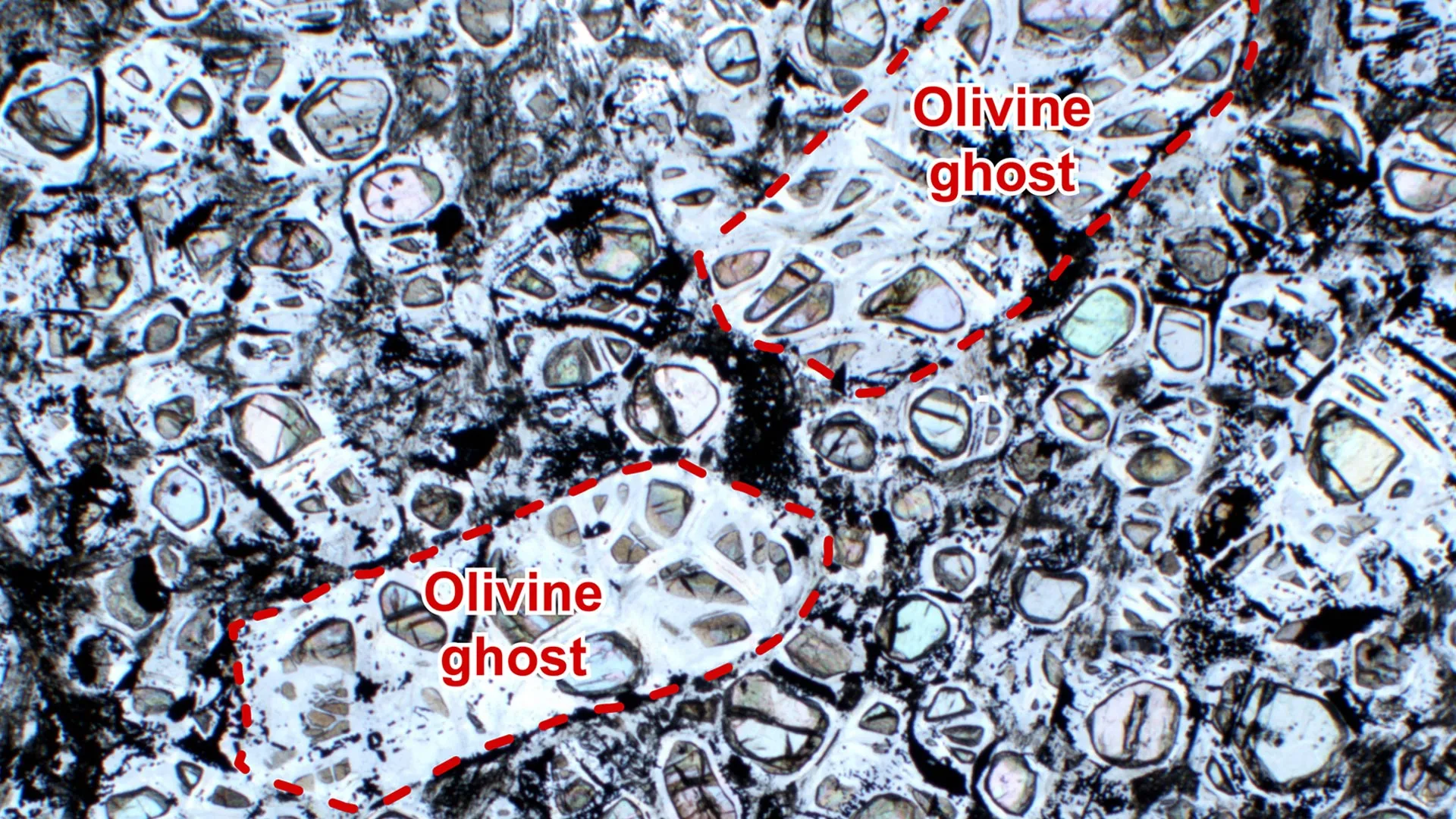
The Hadean Eon, which stretched from 4.6 to 4.0 billion years ago, represents one of the least understood periods in Earth's past. This era opened with the birth of the planet and was quickly followed by a dramatic collision with a Mars-sized object. The impact produced the Moon and left Earth's interior completely molten. A solid crust began forming around 4.5 billion years ago, although scientists have long debated what unfolded after that point.
For many years, researchers believed that Earth remained in a "stagnant lid" state until at least the end of the Hadean. According to this idea, the planet was capped by a stiff, unmoving outer shell while heat-driven convection took place deeper in the mantle. In this scenario, the early planet lacked subduction (the process in which crust sinks into the interior) and did not yet produce the continental crust seen in today's plate tectonic system.
A New Challenge to the Stagnant Lid Hypothesis
Now, scientists from the ERC Synergy Grant Project "Monitoring Earth Evolution through Time" (MEET) -- a collaboration between geochemists from Grenoble (France) and Madison (USA), and geodynamic modelers from GFZ Helmholtz Centre for Geosciences in Potsdam (Germany) -- are offering a different interpretation.
Ancient Crystals Reveal Evidence of Early Subduction
In a study published in Nature Communications, the MEET research team reports evidence that both subduction and continental crust formation were not only active during the Hadean but may have been more intense than previously assumed. The Grenoble group analyzed strontium isotopes and trace elements in melt inclusions trapped inside 3.3-billion-year-old olivine crystals, providing rare geochemical snapshots of early Earth. At the same time, the GFZ group applied advanced geodynamic models to understand how these geochemical patterns relate to ancient tectonic activity.
Their combined results point to a far livelier early Earth, suggesting that widespread subduction and the growth of continental crust may have begun several hundred million years earlier than earlier theories proposed.
Glossary of Key Terms
Hadean Eon: The earliest chapter of Earth's history (4.6 to 4.0 billion years ago), beginning with the planet's formation and characterized by extreme heat and frequent impacts.
Subduction: A tectonic process in which one piece of Earth's crust sinks beneath another and moves downward into the mantle.
Stagnant lid: A tectonic state where the planet's outer shell is rigid and unmoving, with very little surface recycling compared to modern plate tectonics.
Mantle convection: The slow, heat-driven movement of material within Earth's mantle that transports energy from the interior toward the surface.
Continental crust: The thick, buoyant type of crust that forms Earth's continents, distinct from the thinner oceanic crust.
Melt inclusions: Tiny pockets of trapped molten material found inside crystals, preserving chemical information about the environment in which the crystals formed.
Olivine crystals: Greenish mineral grains commonly found in Earth's mantle and volcanic rocks; they can preserve ancient geochemical clues.
Strontium isotopes: Different forms of the element strontium used by scientists to determine the origin and history of rocks and magmas.
Geodynamic simulations: Computer models that recreate how Earth's interior moves and evolves over time.
Crustal solidification: The process by which Earth's once-molten surface cooled and hardened into a solid crust.
Story Source:
Materials provided by GFZ Helmholtz-Zentrum für Geoforschung. Note: Content may be edited for style and length.
Journal Reference:
- Adrien Vezinet, Aleksandr V. Chugunov, Alexander V. Sobolev, Charitra Jain, Stephan V. Sobolev, Valentina G. Batanova, Evgeny V. Asafov, Alina N. Koshlyakova, Nicholas T. Arndt, Leonid V. Danyushevsky, John W. Valley. Growth of continental crust and lithosphere subduction in the Hadean revealed by geochemistry and geodynamics. Nature Communications, 2025; 16 (1) DOI: 10.1038/s41467-025-59024-6
Cite This Page: