
A tiny citrus pest is hiding a biological mystery never seen before
A strange ribosome-filled tube inside a citrus-pest symbiont may rewrite bacterial biology and inspire new pest-control solutions.
- Date:
- December 4, 2025
- Source:
- Toyohashi University of Technology (TUT)
- Summary:
- Scientists have discovered a strange tubular structure inside Profftella, a symbiotic bacterium in the Asian citrus psyllid. These long, helical tubes, filled with ribosomes, show a complexity not typically found in bacteria. The discovery reshapes ideas about bacterial evolution and internal architecture. It may also help create targeted methods to control a major global citrus pest.
- Share:
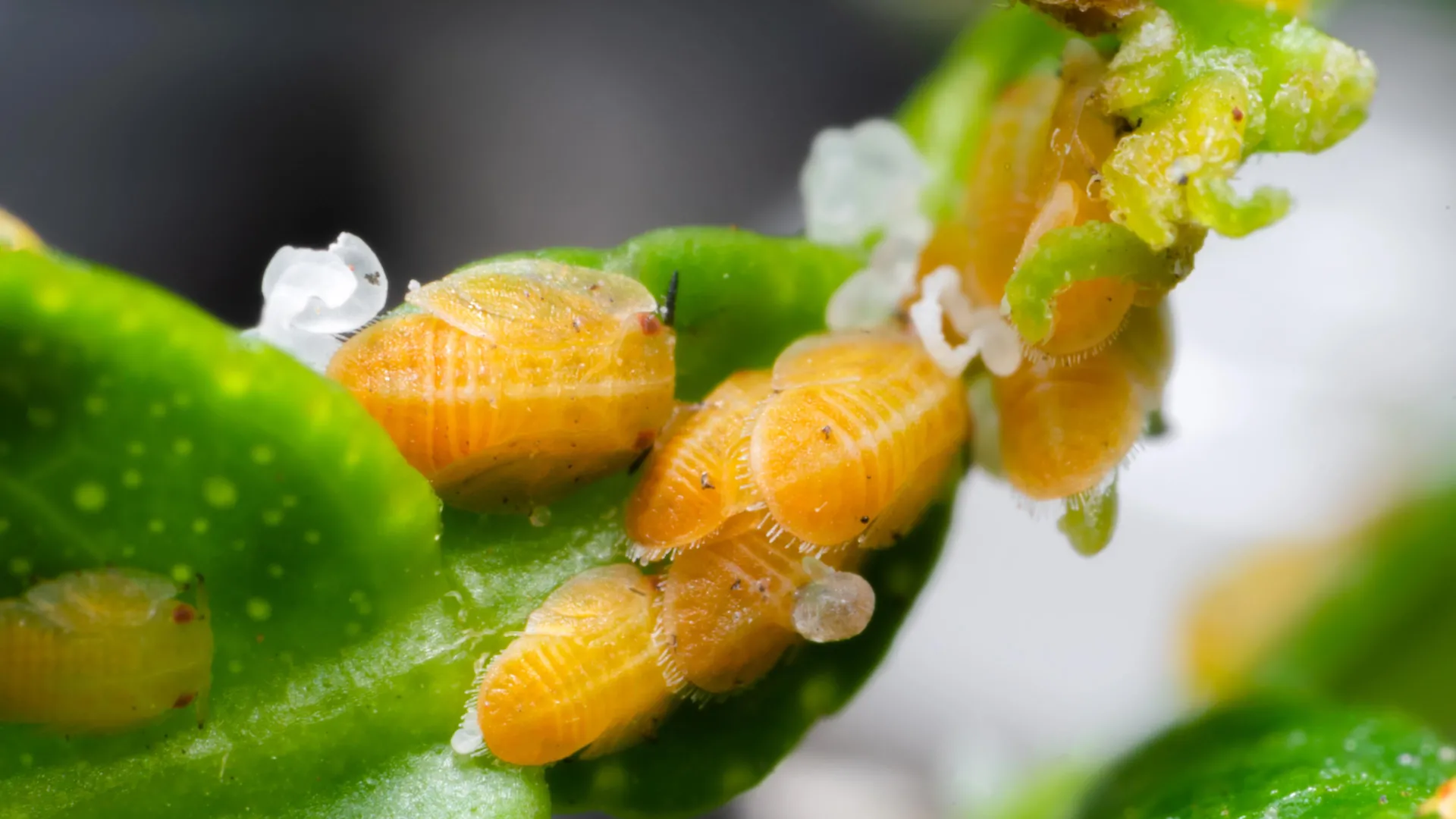
A multinational group of scientists has identified a previously unknown tubular structure within Profftella, a symbiotic bacterium linked to a major pest that affects citrus crops around the world. The finding was made possible through advanced microscopy techniques and could influence future approaches to pest management as well as research on how complex biological features evolve.
A collaborative team from Pusan National University, the National Institute for Physiological Sciences, Kobe University, and Toyohashi University of Technology reported the discovery of this unusual tube-like structure within Candidatus Profftella armatura, which lives inside the Asian citrus psyllid (Diaphorina citri). Their results appear in Npj Imaging.
Advanced Imaging Reveals Large Helical Tubes in Profftella
The Asian citrus psyllid is an important agricultural threat responsible for severe citrus crop losses worldwide, ultimately affecting both yield and market prices. The insect carries Profftella, a symbiotic bacterium that is passed from parent to offspring and plays a key role in the insect's survival. Profftella is also known for producing toxic compounds that help the psyllid defend itself from predators.
Using 3D electron microscopy, researchers observed that Profftella cells are extremely elongated, reaching lengths of more than 100 micrometers. Inside these stretched cells, the team identified multiple long tubular structures, each spanning tens of micrometers. The tubes measure about 230 nm in diameter and are made of 5 to 6 right-handed helical fibers that twist together. They consistently occupy a substantial part of each Profftella cell. Assistant Professor Chihong Song of Pusan National University, the study's first author, noted, "Typically, bacteria lack such complex organelles. Moreover, I was surprised to find that this tube is so stable and robust that it maintains its shape during high-vacuum electron microscopy observation without chemical fixation or embedding."
Tubules Packed With Ribosomes Suggest New Biological Functions
Follow-up studies using additional methods, including optical microscopy, revealed that the interior of these tubes contains many ribosomes, the structures responsible for protein production. Associate Professor Atsushi Nakabachi of Toyohashi University of Technology, a corresponding author of the work, explained, "Based on this, the tubes may be involved in protein synthesis. Given their sturdiness, they could also provide physical support to the elongated Profftella cells, and maybe even act like a scaffold for material transport -- kind of like the cytoskeleton in eukaryotic cells."
Implications for Bacterial Evolution and Citrus Pest Control
The researchers highlight that this tubular structure represents an exceptionally rare example of an organelle within bacteria. Its discovery challenges long-standing assumptions that bacteria are inherently simple and lack such internal complexity. The finding offers new clues into how cellular features may have evolved and could contribute to the development of targeted strategies to manage the Asian citrus psyllid, which is a serious concern for global agriculture.
This study received funding from the Japan Society for the Promotion of Science KAKENHI (grant numbers 21687020, 26292174, 20H02998 and 25K02023 to AN), the Collaborative Study by High Voltage Electron Microscopy Program (2015-502, 2016-502) of National Institute for Physiological Sciences to AN, and a National Research Foundation of Korea (NRF) grant RS-2024-00440289 to CS.
Story Source:
Materials provided by Toyohashi University of Technology (TUT). Note: Content may be edited for style and length.
Journal Reference:
- Chihong Song, Junnosuke Maruyama, Kazuyoshi Murata, Toshinobu Suzaki, Atsushi Nakabachi. Enigmatic tubular ultrastructure in the bacterial defensive symbiont of the Asian citrus psyllid Diaphorina citri. npj Imaging, 2025; 3 (1) DOI: 10.1038/s44303-025-00107-w
Cite This Page: