
NASA’s Perseverance confirms a key ingredient for life hidden in ancient Mars rocks
- Date:
- November 12, 2026
- Source:
- Science Advances
- Summary:
- NASA's Perseverance rover has confirmed complex organic carbon just beneath the surface of ancient Martian rocks, raising intriguing questions about the Red Planet's potential to have supported life. The remarkable preservation of these compounds, along with similar discoveries thousands of miles away, suggests the building blocks of life may once have been widespread across Mars.
- Share:
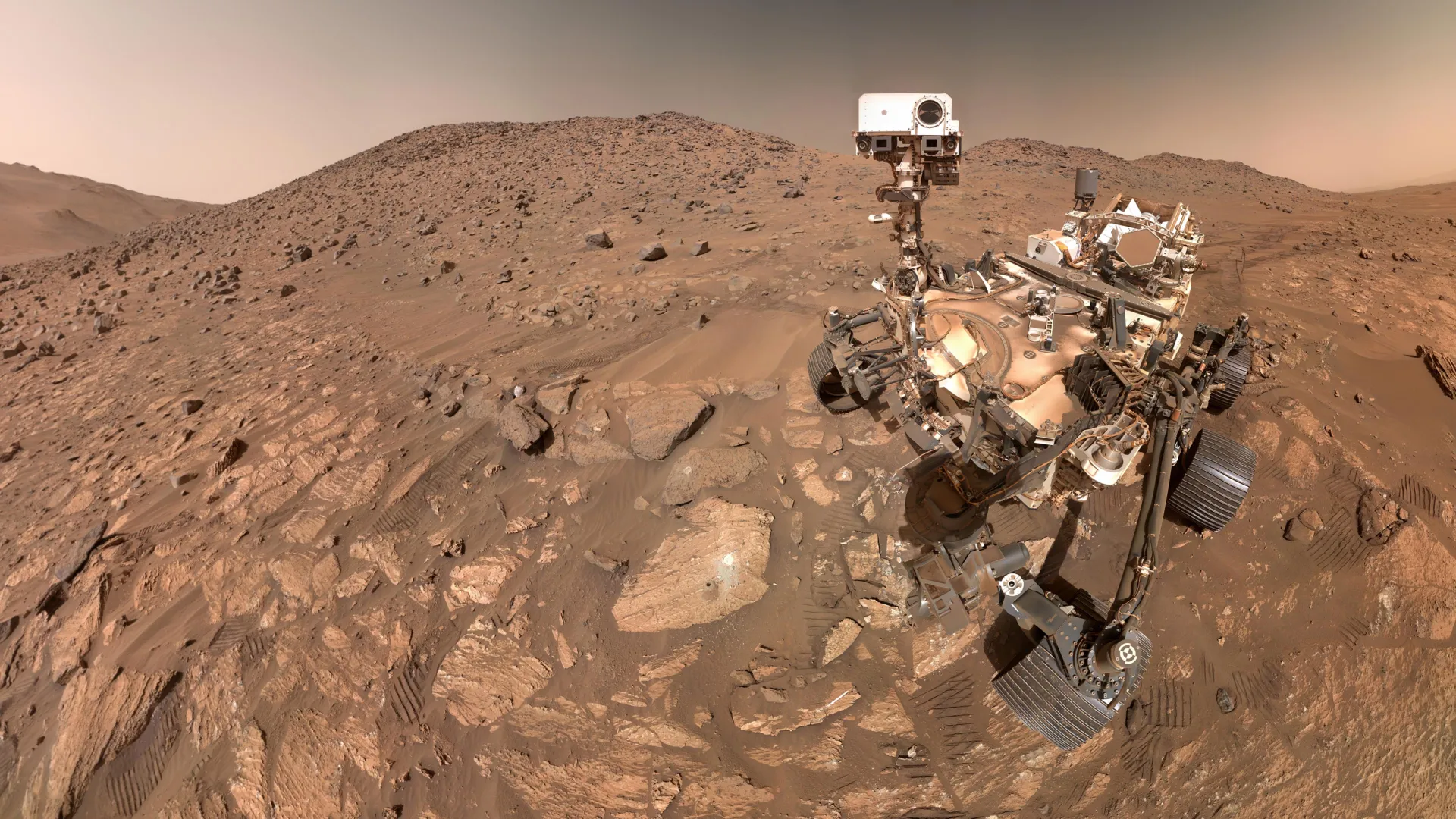
Organic carbon has been confirmed in two ancient Martian rocks examined by NASA's Perseverance rover, adding an important new piece to the puzzle of whether Mars once supported life. Even more surprising, the material was found just beneath the planet's surface, where harsh conditions can destroy organic compounds.
The discovery builds on NASA's September 2025 announcement that Perseverance had identified a potential biosignature. A potential biosignature is a substance or feature that could have formed through biological activity, although other explanations are possible. Now, research published in Science Advances provides definitive confirmation that the same two rocks, located in Mars' Bright Angel formation, contain organic carbon, an essential component of life. The findings also offer a clearer picture of the material's characteristics and how it may have been preserved.
The study was co-led by Ashley Murphy, a postdoctoral researcher at the Planetary Science Institute, and Kyle Uckert, Deputy Principal Investigator of the SHERLOC instrument.
NASA's Perseverance Rover Detects Complex Organic Carbon
To investigate the rocks, researchers used the Scanning Habitable Environments with Raman & Luminescence for Organics & Chemicals (SHERLOC) instrument mounted on Perseverance's robotic arm. The instrument examined several rocks in the Bright Angel formation within Jezero crater, where the rover also collected a sample from a rock named "Cheyava Falls."
SHERLOC uses a technique called Raman spectroscopy, which shines laser light onto a material to identify and map its minerals and organic compounds without damaging the rock.
The measurements revealed macromolecular carbon (MMC), a form of carbon consisting of large, interconnected networks of carbon atoms. This type of material is also found in rocks on Earth and in meteorites. Importantly, it can form through biological activity or through chemical processes that do not involve life, so its presence alone cannot establish that Mars was once inhabited.
The surrounding geology offers additional clues about how the material reached these rocks. Billions of years ago, water flowed through a river channel into Jezero crater, carrying sediment that gradually settled on the bottom. Over time, those fine particles hardened into the mudstone formations Perseverance is now exploring.
Researchers detected the carbon within these ancient sediments and alongside carbonate and sulfate minerals that developed later as water altered the rocks. This distribution raises the possibility that organic material entered or formed within the rocks during at least two separate periods of Mars' geological history.
"While the specific formation mechanism of the MMC detected in the Bright Angel mudstones remains unknown, this is still one of the most exciting findings to date," Murphy said.
Organic Carbon Survives Just Beneath Mars' Harsh Surface
One of the most striking results concerns where the organic carbon was found. The material survived only a few microns below the exposed Martian surface, at a depth smaller than the thickness of a sheet of paper. This is the shallowest detection of macromolecular carbon ever reported on Mars.
That location makes the finding particularly unusual. Mars' surface is exposed to radiation, sunlight, and chemically reactive substances that can break down organic molecules. Scientists would generally expect these conditions to make long-term preservation especially difficult so close to the surface.
"The Martian surface environment includes radiation and chemical oxidants that are destructive to organics, and terrestrial laboratory simulations have shown that the survival time of organics in Martian-like conditions -- especially at or near the surface -- depends on factors such as the type of organic molecule and the surrounding minerals," Murphy said. "The MMC detected in the Bright Angel mudstones is either resistant to degradation and/or has been sufficiently shielded by other minerals, such as clays, or iron-rich Martian soil."
In other words, the carbon may have survived because of its own chemical durability, protection provided by surrounding minerals, or a combination of the two. Understanding how it endured could help scientists determine where similar organic compounds might remain preserved elsewhere on Mars.
Ancient Martian Lakes and Rivers May Have Been Rich in Organic Material
The findings also suggest that organic carbon may not have been confined to a single region of ancient Mars.
Perseverance collected the Bright Angel sample more than 2,000 miles from Gale Crater, where NASA's Curiosity rover previously detected organic compounds. Finding organic material at such widely separated locations suggests that the chemistry associated with life's building blocks may once have been common across the Martian landscape.
"It is encouraging for Martian habitability," Murphy said. "This indicates that billions of years ago, organics may have been more than just locally present and may have been more widely available in ancient lakes and rivers on Mars."
The possibility of widespread organic material is significant because ancient Mars once had environments containing liquid water. If organic compounds were also broadly available, some of those lakes and rivers may have offered important chemical ingredients for life.
However, discovering those ingredients does not mean that living organisms were present. Organic carbon can be produced without biology, and scientists still need to determine exactly how the material in the Bright Angel rocks formed.
Could Martian Rocks Preserve Evidence of Ancient Life?
Determining whether the Bright Angel formation contains fossilized microorganisms remains beyond the capabilities of the rovers currently exploring Mars. Neither Curiosity in Gale Crater nor Perseverance in Jezero Crater carries the large, energy-intensive laboratory equipment needed to conclusively distinguish fossil evidence of ancient life from geological processes.
Perseverance was designed to search for potential biosignatures, including features like those identified in the Cheyava Falls rock. From that perspective, the discovery represents a "resounding win for Mars science," Murphy said.
The next major step would be to examine Martian samples using the more sophisticated instruments available in laboratories on Earth. Such equipment could reveal details too small or chemically subtle for the rover's instruments to resolve, helping researchers determine whether biological processes or nonliving chemistry produced the organic carbon.
If samples from the Bright Angel formation eventually reach Earth, scientists hope to study their minerals and organic compounds with much greater sensitivity and resolution. These investigations could help explain how the macromolecular carbon formed, how it survived, and what its presence reveals about the distribution of organic material across Mars.
Murphy continues to collaborate with the SHERLOC science team as Perseverance explores the Martian surface. Her research also includes studying Earth materials that resemble Martian rocks and using Raman spectroscopy to improve how scientists interpret the measurements returned by the rover.
Murphy's work on SHERLOC Instrument Mars 2020 was supported through JPL Subcontract No. 1641753 to the Planetary Science Institute.
Story Source:
Materials provided by Science Advances. Original written by Mikayla Mace Kelley. Note: Content may be edited for style and length.
Journal Reference:
- Ashley E. Murphy, Kyle Uckert, Kevin P. Hand, Rohit Bhartia, Sergei V. Bykov, Keyron Hickman-Lewis, Ryan S. Jakubek, Carina Lee, Francis M. McCubbin, Michelle E. Minitti, Alyssa Pascuzzo, Sandra Siljeström, Sunanda Sharma, Andrew Steele, Kenneth H. Williford, William Abbey, Sanford A. Asher, Robert Barnes, Parker A. Barr, James F. Bell, Olivier Beyssac, Tanja Bosak, Michael S. Bramble, Adrian Brown, Adrian P. Broz, Denise Buckner, Emily L. Cardarelli, Joseph L. Carsten, Andrea Corpolongo, Andrew Czaja, Scott G. C. Edgington, Bethany L. Ehlmann, Kenneth A. Farley, Teresa Fornaro, Marc Fries, Roxana González-Burgos, Sanjeev Gupta, Nikole C. Haney, William Hug, Joshua Huggett, Joel A. Hurowitz, Samara Imbeah, Joanna Clark, Alexander J. Jones, Linda C. Kah, Megan R. Kennedy, Steven W. Lee, Justin Maki, Brian Nixon, Jorge I. Núñez, Jeffrey T. Osterhout, Nicole D. Phelan, Yu Yu Phua, Michael A. Ravine, Joseph Razzell Hollis, Eva Scheller, Mitchell D. Schulte, Mark A. Sephton, Justin I. Simon, Anushree Srivastava, Kathryn M. Stack, Jason Van Beek, Benjamin P. Weiss, Roger Wiens, Amy J. Williams, Brittan V. Wogsland, R. Aileen Yingst. Spatially distributed complex organic matter detected in an ancient river valley in Jezero crater, Mars. Science Advances, 2026; 12 (26) DOI: 10.1126/sciadv.adx0047
Cite This Page: