
NASA captures a stunning transformation in Australia's red outback
- Date:
- October 12, 2026
- Source:
- NASA Earth Observatory
- Summary:
- Australia's normally dry, rust-colored outback has erupted into a spectacular carpet of wildflowers after unusually heavy rains, potentially producing its most impressive bloom in nearly 20 years. NASA satellite images capture the stunning transformation, which has even brought rare flowers to the grounds of a remote deep-space observatory.
- Share:
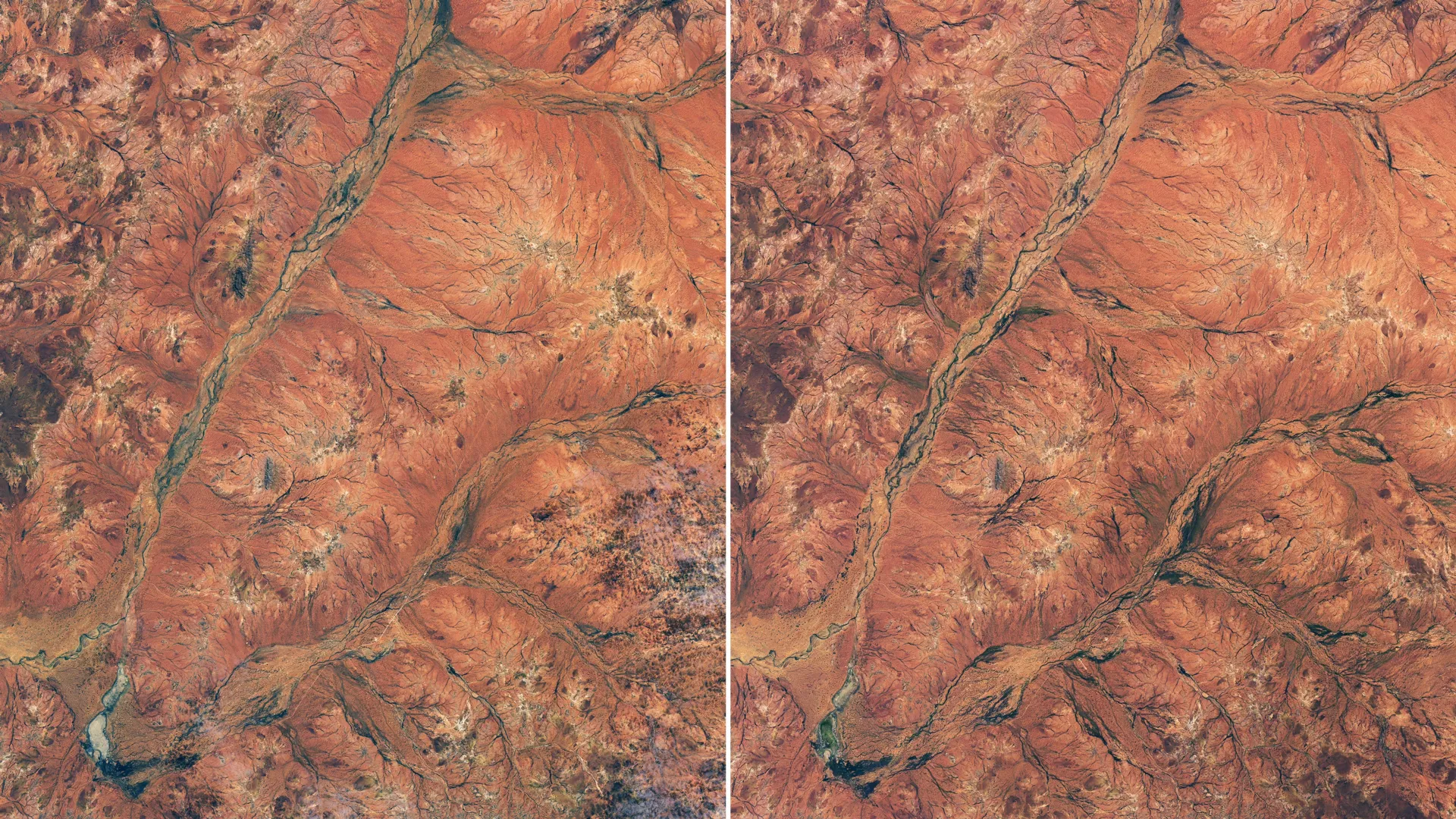
A spectacular explosion of wildflowers has transformed the normally dry, rust-colored landscape of Western Australia into a vibrant patchwork of green and colorful blooms. The remarkable display followed months of unusually wet weather, awakening seeds that had been lying dormant beneath the soil.
By late winter 2026 in the Southern Hemisphere, large stretches of the region's arid shrubland were covered in flowers. Local experts believe this could be the most impressive wildflower season the area has experienced in nearly 20 years.
NASA satellite imagery reveals just how dramatically the landscape changed in a single year.
NASA Satellite Images Reveal a Dramatic Transformation
The images above were collected by the OLI (Operational Land Imager) aboard the NASA-USGS Landsat 8 satellite. They show the same part of Western Australia in late August 2025 (left) and late August 2026 (right), highlighting the striking increase in vegetation following the unusually wet conditions.
The location is in the Murchison region, approximately 600 kilometers (370 miles) north of Perth. This remote stretch of the Australian outback is an important grazing area for sheep and cattle, with a landscape typically dominated by hardy plants adapted to limited rainfall.
Much of the region's vegetation consists of grasses, saltbush, and mulga, a slow-growing evergreen tree capable of surviving in dry conditions. Wildflowers also emerge periodically, but their abundance can vary dramatically depending on how much rain falls.
Unusually Heavy Rains Trigger a Wildflower Explosion
The exceptional display in 2026 was made possible by a series of cold fronts that carried much-needed moisture into the region.
According to Australia's Bureau of Meteorology, June brought above-average rainfall, while August was much wetter than normal. These favorable conditions allowed seeds that had remained inactive in the dry soil to germinate, producing an extraordinary variety of wildflowers across the landscape.
The colorful transformation extended into the grounds of a radio astronomy observatory operated by the Commonwealth Scientific and Industrial Research Organisation (CSIRO), Australia's national science agency.
Among the flowers were several threatened species, adding ecological significance to the seasonal spectacle. The observatory has helped track these vulnerable plants on land that was previously used for livestock grazing.
Where Wildflowers Bloom Beneath Deep-Space Telescopes
While the flowers created an extraordinary scene on the ground, the observatory's usual work takes place far beyond Earth's atmosphere.
Known as Inyarrimanha Ilgari Bundara, the CSIRO Murchison Radio-astronomy Observatory is a remote research facility dedicated to studying the universe through radio astronomy. Its antenna arrays detect radio signals from celestial objects, allowing scientists to observe and catalog sources across the southern sky.
The observatory's isolated location is particularly important for this work. It sits within a designated "radio quiet" zone, where communication systems and electronic equipment are restricted to reduce interference with sensitive scientific instruments.
Even relatively weak signals generated by human technology can interfere with radio observations, so limiting these disturbances helps astronomers detect faint emissions traveling across space.
Australia's Radio Telescopes Have Helped NASA Explore Space
Australia's radio astronomy facilities have a long history of supporting some of NASA's most important space missions.
The Murriyang radio telescope, located in Parkes, New South Wales, helped track Mariner 2 in 1962. That spacecraft became the first successful planetary science mission, marking a major milestone in the exploration of other worlds.
The telescope also played a significant role during the Apollo 11 Moon landing in 1969, serving as an important receiving station for communications from the historic mission.
CSIRO additionally manages the Canberra Deep Space Communication Complex, one of three major facilities that make up NASA's worldwide Deep Space Network.
This global system maintains communications with spacecraft traveling throughout the solar system and beyond, while also supporting radar measurements and radio astronomy research.
Both the Murriyang telescope and the Canberra complex contributed to NASA's Artemis II mission in April 2026, continuing Australia's decades-long involvement in space exploration.
For a brief period in 2026, however, one of Australia's most remote astronomical research regions offered a remarkable spectacle much closer to home. While its telescopes continued scanning the distant universe, unusually generous winter rains brought the surrounding outback to life in a brilliant display of wildflowers.
Story Source:
Materials provided by NASA Earth Observatory. Original written by Lindsey Doermann. Note: Content may be edited for style and length.
Cite This Page: