
Scientists finally see DNA “zip” itself together for the first time
Researchers have captured the moment two DNA molecules zip together, solving a decades-old mystery.
- Date:
- September 14, 2026
- Source:
- University of York
- Summary:
- Scientists have directly observed how two negatively charged DNA molecules can pair up despite normally repelling each other. Positively charged metal ions appear to bridge the gap, helping matching DNA helices align groove for groove like a molecular zipper. The discovery confirms a theory proposed two decades ago and could help researchers understand DNA interactions involved in cancer and other cellular processes.
- Share:
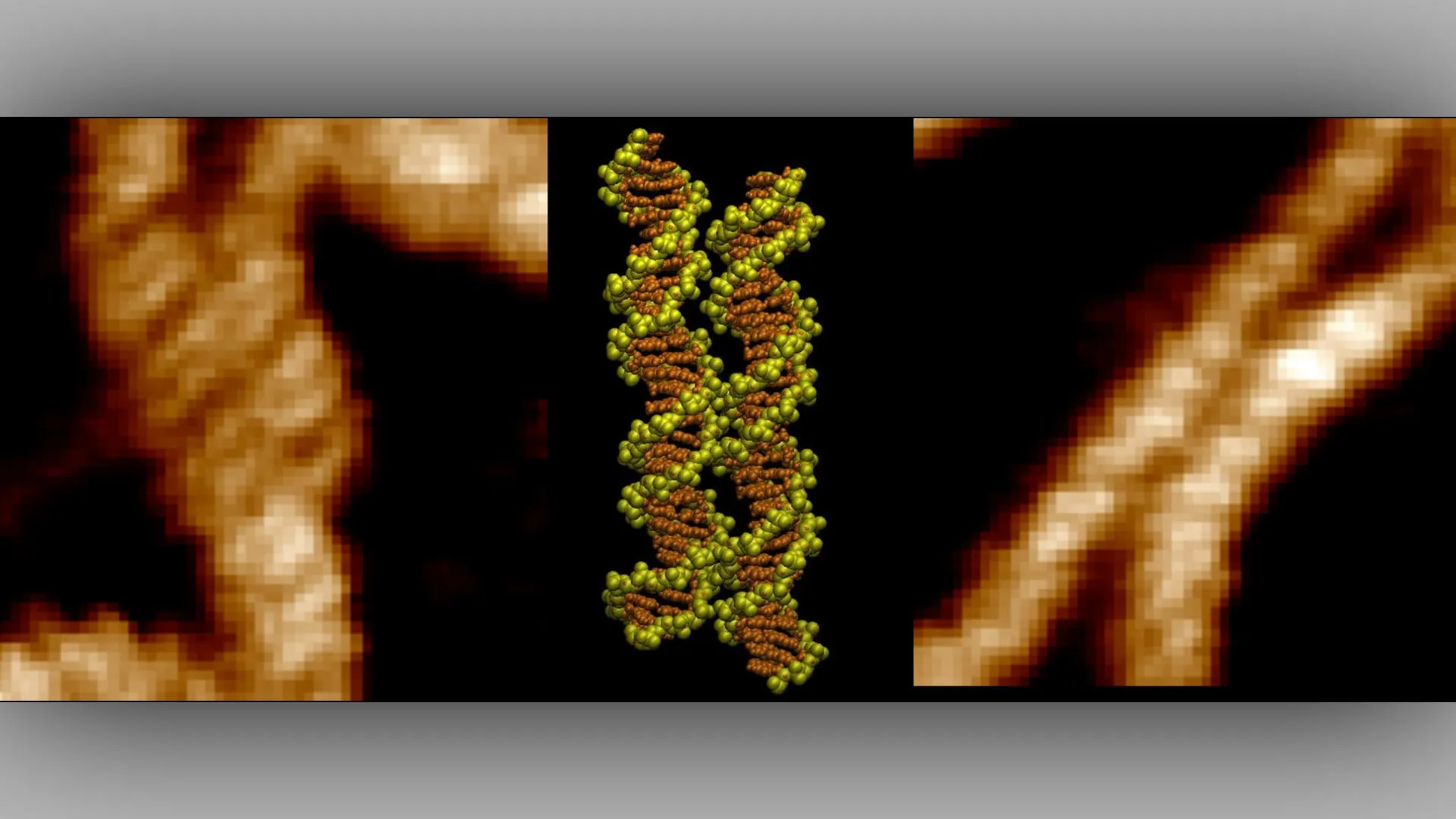
DNA carries a negative electrical charge. Because objects with the same charge normally push away from each other, DNA molecules might be expected to repel one another. Yet inside living cells, DNA must sometimes come into close contact and recognize matching sequences. These interactions are essential for processes including genetic recombination and gene silencing, and they can also play a role in cancer.
Scientists have now captured a remarkably detailed view of how this happens. Using powerful atomic force microscopy, researchers watched short pieces of DNA align with extraordinary precision, matching one another groove for groove. Computer simulations then revealed what appears to make this close contact possible: positively charged metal ions can settle into the grooves of DNA and serve as tiny molecular bridges between the two molecules.
Tiny Ions Help DNA Overcome Repulsion
Professor Agnes Noy, from the School of Physics, Engineering and Technology at the University of York, co-led the research. She said: "This discovery could help researchers identify regions of the genome specially involved in DNA pairing. These regions may become particularly important when mutations disrupt normal cellular processes and contribute to cancer."
The results provide experimental support for an idea proposed about twenty years ago called the "DNA zipper" model. Professor Alexey Kornyshev from Imperial College London and his collaborators originally suggested that salt ions surrounding DNA could produce alternating patterns of electrical charge. Those patterns, according to the model, would help neighboring DNA molecules align with one another much like two interlocking spiral staircases.
Until now, directly observing this proposed mechanism had proved difficult.
Scientists Put the "DNA Zipper" to the Test
To investigate the process, the researchers scanned DNA samples with atomic force microscopy, a technique capable of mapping surfaces at extremely small scales. These scans allowed the team to construct detailed topographical maps showing how the DNA molecules were positioned.
At the same time, sophisticated computer simulations followed individual atoms and ions as they moved around the DNA. Combining the two approaches gave researchers both a direct view of DNA pairing and a way to understand the molecular forces responsible for it.
The simulations showed that double-charged metal ions can effectively behave like two charged arms. Each ion can interact with both DNA molecules at once, forming a bridge across the space separating them and helping hold the two strands in alignment.
Dr. Thomas Catley, co-lead author from the School of Chemical Materials and Biological Engineering at the University of Sheffield, said: "It was incredible to be able to directly visualize the long-hypothesized mechanism for the first time. The advanced imaging techniques at our disposal are allowing us to uncover these key DNA interactions which have implications in many key cellular processes."
Dr. Victor Velasco-Berrelleza from the University of Sheffield, who performed the simulations, added: "Microscopy shows us what happens, but the simulations allow us to uncover the molecular mechanism behind it."
Some DNA Sequences Pair More Strongly
The researchers also found that DNA does not pair equally well along every sequence. Some stretches of DNA created much stronger contacts than others, producing distinct hotspots where two helices were especially likely to line up.
That finding could help researchers pinpoint parts of the genome that are particularly involved in DNA recognition and pairing. Such regions may become especially significant when mutations interfere with normal cellular activity and contribute to cancer.
The discovery could also have uses beyond medicine. Because some DNA sequences can be programmed to interact more strongly than others, scientists may eventually be able to take advantage of these properties to build customized DNA structures for biotechnology.
The study, "Imaging and mechanism of DNA-DNA recognition mediated by divalent ions," was published in the journal Nucleic Acids Research.
Story Source:
Materials provided by University of York. Note: Content may be edited for style and length.
Journal Reference:
- Thomas E Catley, Victor Velasco-Berrelleza, Daniel E Rollins, Alice L B Pyne, Agnes Noy. Imaging and mechanism of DNA–DNA recognition mediated by divalent ions. Nucleic Acids Research, 2026; 54 (16) DOI: 10.1093/nar/gkag817
Cite This Page: