
Archaeologists discover mysterious 400-year-old Indigenous pot in Florida
- Date:
- August 21, 2026
- Source:
- Florida Museum of Natural History
- Summary:
- A tiny, fully intact Indigenous pot buried for roughly 400 years has left archaeologists wondering why such a usable object was deliberately abandoned. Found at a historic Potano-Timucua village in Florida, the mysterious vessel is helping reveal a complex world of Native traditions, Spanish influence, trade, and migration.
- Share:
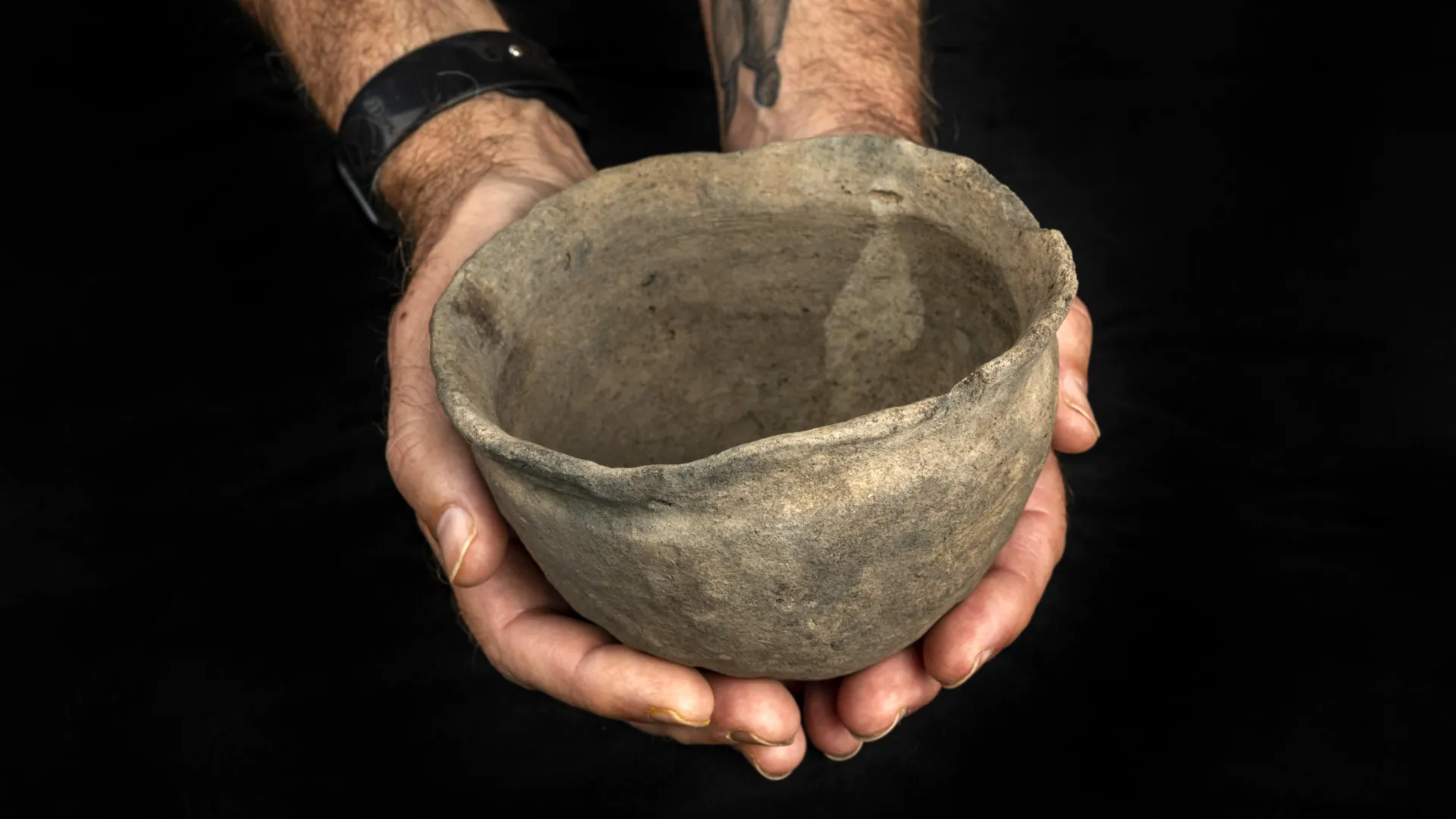
Roughly 400 years ago, a member of the Indigenous Potano-Timucua tribe shaped a small clay vessel by hand. The pot was compact enough to fit in a palm, with a simple rim, a smooth dull gray surface, and no decoration. Its original purpose is unknown, as is the number of people who may have used it. What archaeologists do know is that the vessel survived for centuries underground before University of Florida students uncovered it earlier this year, still completely intact.
"It's very unique. Typically, we find things that were broken and discarded," said Gifford Waters, collections manager for historical archaeology at the Florida Museum of Natural History. "You don't leave things behind that you can still use, so why was this purposefully put into a pit?"
Waters has encountered complete artifacts while working with shipwreck collections, where intact objects are more common. But this was the first time in his career that he had been part of a team that excavated an entirely unbroken pottery vessel from a terrestrial site. Even pottery that enters the ground whole often cracks over the centuries as soil pressure, farming, construction, and other disturbances shift the earth around it.
Students Explore a Centuries-Old Florida Mission
The discovery was made by students taking a field course taught by Waters and Charles Cobb, curator of historical archaeology at the museum. Each Friday during the spring semester, students practice the basic techniques of archaeological fieldwork while investigating Mission San Francisco de Potano, a centuries-old site in northwest Gainesville.
The former mission is now a wooded area marked by 1-by-1 meter (approximately 3-by-3 foot) excavation squares. Students carefully remove soil with trowels while moving along paths between areas containing the remains of a 17th-century kitchen, a friar's residence, and the surrounding Potano village.
The Potano were part of the Timucua people of North Florida. In 1585, they relocated to the area after Spanish forces forced them from their earlier home, which was probably situated between present-day Payne's Prairie and Orange Lake.
In 1606, Spain sent a friar to the Potano village to establish a mission. It became one of the earliest of more than 100 Catholic missions founded during the following century as Spain worked to maintain control of Florida. Mission San Francisco de Potano was abandoned in 1706, and physical traces of the settlement gradually disappeared from view until artifacts began to turn up in the 1950s.
Thousands of Artifacts Reveal Daily Life
At its height, the village likely contained several hundred Potano residents, while the mission itself was home to just one European, the friar. That population balance helps explain why most of the more than 7,000 artifacts recovered from the site since 2006 are fragments of Native American pottery.
Other discoveries include glass beads, stone tools, nails, and animal bones from meals that included turtle, freshwater fish, and turkey.
"What tells us the most is not just the artifacts but the evidence of activities. Knowing that we have a bunch of pieces of bone at the site is great, but the fact we know that nearly all of them came from one spot tells us it was a cooking area and trash pit," Waters said. "It's not just artifacts themselves but where they were on the site, how they were distributed and what they were associated with that tells the story."
For archaeologists, an object's location and its relationship to nearby finds can be just as informative as the artifact itself. Although the intact pot has not provided many direct clues about how it was used, its archaeological setting adds another piece to the larger history being reconstructed at the site.
A Pot Found Inside a Mysterious Spanish Structure
The vessel was discovered within a Spanish-made structure whose purpose has not yet been determined. More excavation will be needed before researchers can identify exactly what happened there.
Historical records indicate that a small military garrison was stationed at the mission after British attacks on missions became more frequent in the early 1700s. One possibility is that the structure served as a barrack. A gun's rear sight and a musket side plate found nearby offer some support for that interpretation.
The pot's depth and position suggest that it was probably made during the roughly century-long period when the mission was occupied. However, archaeologists do not recognize the vessel's particular style, and its function remains uncertain.
Cooking vessels often retain traces of burned food and charcoal on their interiors. This pot lacks that type of residue, suggesting that it probably was not placed directly over a fire for cooking.
It still may have played a role in meals. Faint scorch marks could have formed when the pot was originally fired, or they may have appeared later if the vessel was set close to a fire to warm individual servings of food.
Pottery Points to Trade, Migration, and Cultural Change
Not long after the intact vessel was discovered, students found fragments from a second, much larger piece of pottery that looked very different.
Instead of the smaller pot's smooth surface, the larger vessel was rough, and its material does not appear to match established local pottery traditions. Archaeologists think it could have reached the village through trade with communities in St. Augustine or present-day Jacksonville. Another possibility is that it arrived with a new resident who brought different pottery traditions to the settlement.
The contrasting artifacts reflect a village connected to a broader network of movement and exchange. People, objects, and ideas passed through the community, and those interactions left physical traces that archaeologists can still identify centuries later.
"During the later years of this mission, folks from different parts of Florida and Native Americans from different areas moved into and around the site. It's really neat to see these differences and connections in the artifacts," Waters said. "It shows both the persistence and change of traditions over time."
Story Source:
Materials provided by Florida Museum of Natural History. Original written by Brooke Bowser. Note: Content may be edited for style and length.
Cite This Page: