
Dogs can tell fear from sadness — and scientists saw it in their brains
- Date:
- August 11, 2026
- Source:
- Cell Press
- Summary:
- Dogs may understand our emotions more deeply than scientists realized. Brain scans show that happy human faces activate regions in dogs linked to higher-level processing and reward, suggesting that smiles carry special emotional significance for them.
- Share:
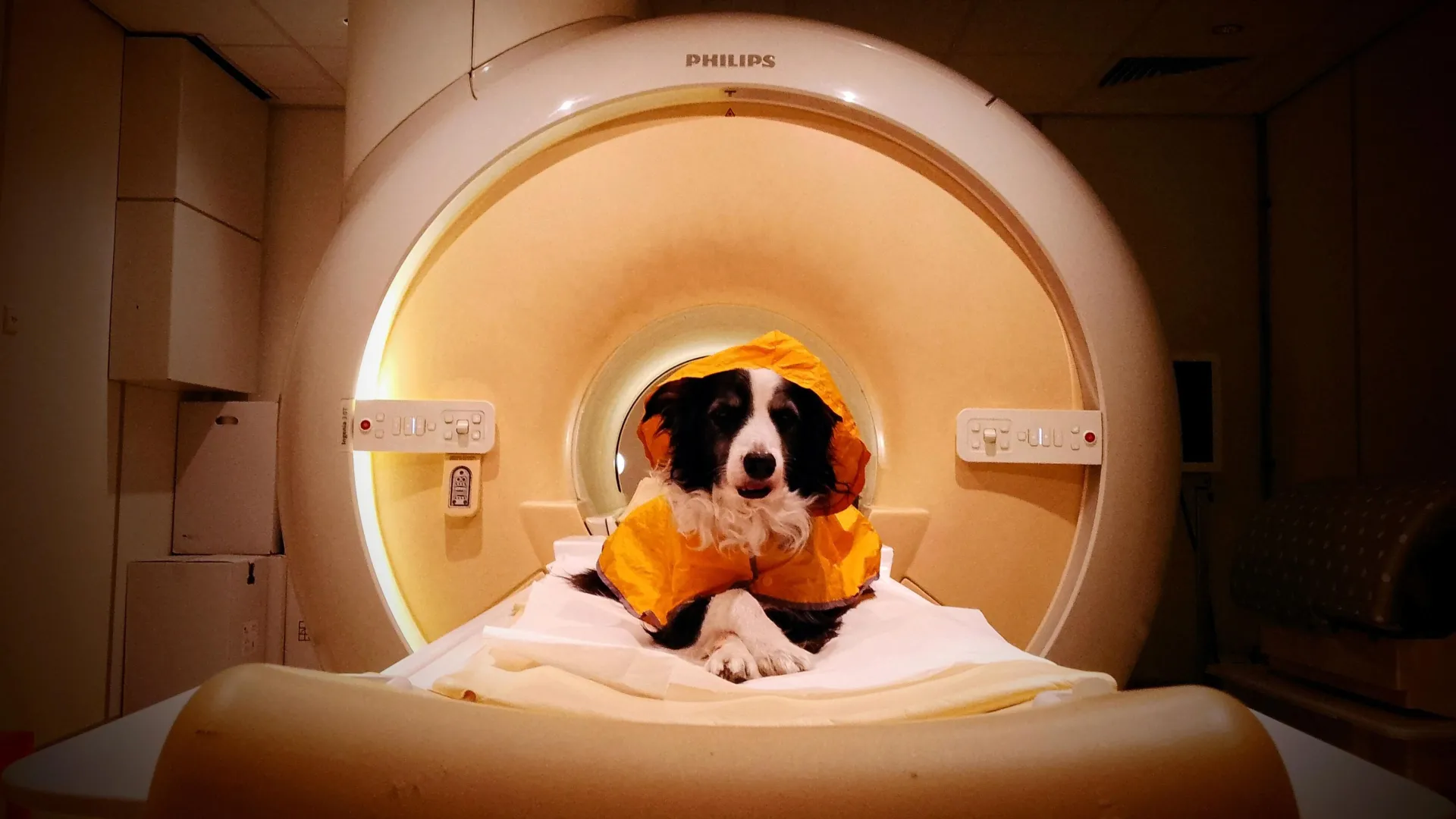
Dogs are exceptionally skilled at reading human emotions, from smiles and laughter to frowns and tears. Scientists and dog owners have recognized this ability for years, but the biological mechanisms that make it possible have remained largely unknown.
A study published August 7 in the Cell Press journal iScience offers a closer look at what happens inside a dog's brain when it sees different human facial expressions. Researchers found that smiles trigger distinctive activity in specific parts of the canine brain. They also uncovered the first evidence that dogs can tell apart several negative expressions, including anger, sadness, and fear.
"Humans are really good at picking up small details on the face, and so are dogs," says first author Raúl Hernández-Pérez from the University of Vienna. "This makes dogs very interesting. By studying their brains, we can understand what adaptations have developed to support their remarkable social and emotional understanding of humans."
How Dogs' Brains Respond to Human Smiles
The researchers began by examining happiness, since earlier research has suggested that positive human expressions may be especially meaningful to dogs.
They scanned the brains of eight dogs while the animals viewed pictures of unfamiliar people showing either happy or neutral expressions. When the dogs saw happy faces, activity increased in the temporal cortex and caudate nucleus. These brain areas are associated with higher-level cognitive processing and reward, respectively.
"The activity in the caudate nucleus is particularly interesting," says Laura Cuaya, also of the University of Vienna, who began the research at the National Autonomous University of Mexico and later expanded it through a collaboration at Eötvös Loránd University in Hungary. "It suggests that happy human faces may have emotional significance for dogs."
The scientists then wanted to know whether these same brain regions reacted differently to other emotions. In a second experiment, 12 dogs were shown images of people expressing happiness, anger, fear, and sadness. The researchers used machine learning to analyze the resulting patterns of brain activity.
The dogs did not respond to all negative expressions in the same way. Activity in the temporal cortex and caudate nucleus network was particularly distinctive when the dogs saw happy faces, making it relatively easy for researchers to separate responses to smiles from responses to anger, fear, and sadness.
Dogs Can Tell Negative Emotions Apart
The findings also showed that dogs were doing more than simply dividing human expressions into positive and negative categories.
A whole-brain analysis revealed different patterns of neural activity for fear compared with anger and sadness. According to the researchers, this is the first evidence that dogs can distinguish among specific negative human facial expressions.
That does not necessarily mean dogs experience emotions in the same way people do. The researchers also point out that a still image captures only a small part of real-world communication. Dogs normally interpret people using many signals at once, including facial expressions, body language, tone of voice, and scent.
"When we compare humans with primates, we are looking at abilities that may have come from a common ancestor," says senior author Laura Cuaya of the University of Vienna. "With dogs, the story is totally different. They followed a very different evolutionary path, yet through domestication, they developed the social abilities needed to understand and cooperate with us."
Domestication May Have Shaped Dogs' Social Skills
All of the dogs in the study were pets living with families. The researchers note that free-ranging dogs, including those that live on the street, experience a very different social environment and may interpret human signals differently.
Future studies will take a more dog-centered approach to explore how dogs combine different brain signals when trying to understand the people around them. The researchers also plan to compare how dogs and humans process the same emotional information.
"I would like people to see dogs as emotional beings," says Cuaya. "They have evolved with us to understand our expressions and cooperate with us, and recognizing that can change how we communicate with and care for them."
Story Source:
Materials provided by Cell Press. Note: Content may be edited for style and length.
Journal Reference:
- Raúl Hernández-Pérez, Luis Concha, Attila Andics, Rodolfo Bernal-Gamboa, Laura V. Cuaya. Dog brain representations of human facial expressions: Encoding happiness and differentiating specific negative expressions. iScience, 2026; 116900 DOI: 10.1016/j.isci.2026.116900
Cite This Page: