
The hidden skeleton “gatekeeper” inside brain cells could help fight Alzheimer's
- Date:
- July 15, 2026
- Source:
- Penn State
- Summary:
- Researchers have discovered that a microscopic skeleton inside neurons does much more than hold cells together. It acts as a gatekeeper that controls what brain cells absorb and when they absorb it. When this protective structure weakens, neurons rapidly take in harmful proteins associated with Alzheimer's disease, suggesting that stabilizing it could become a promising new strategy for preventing brain cell damage.
- Share:
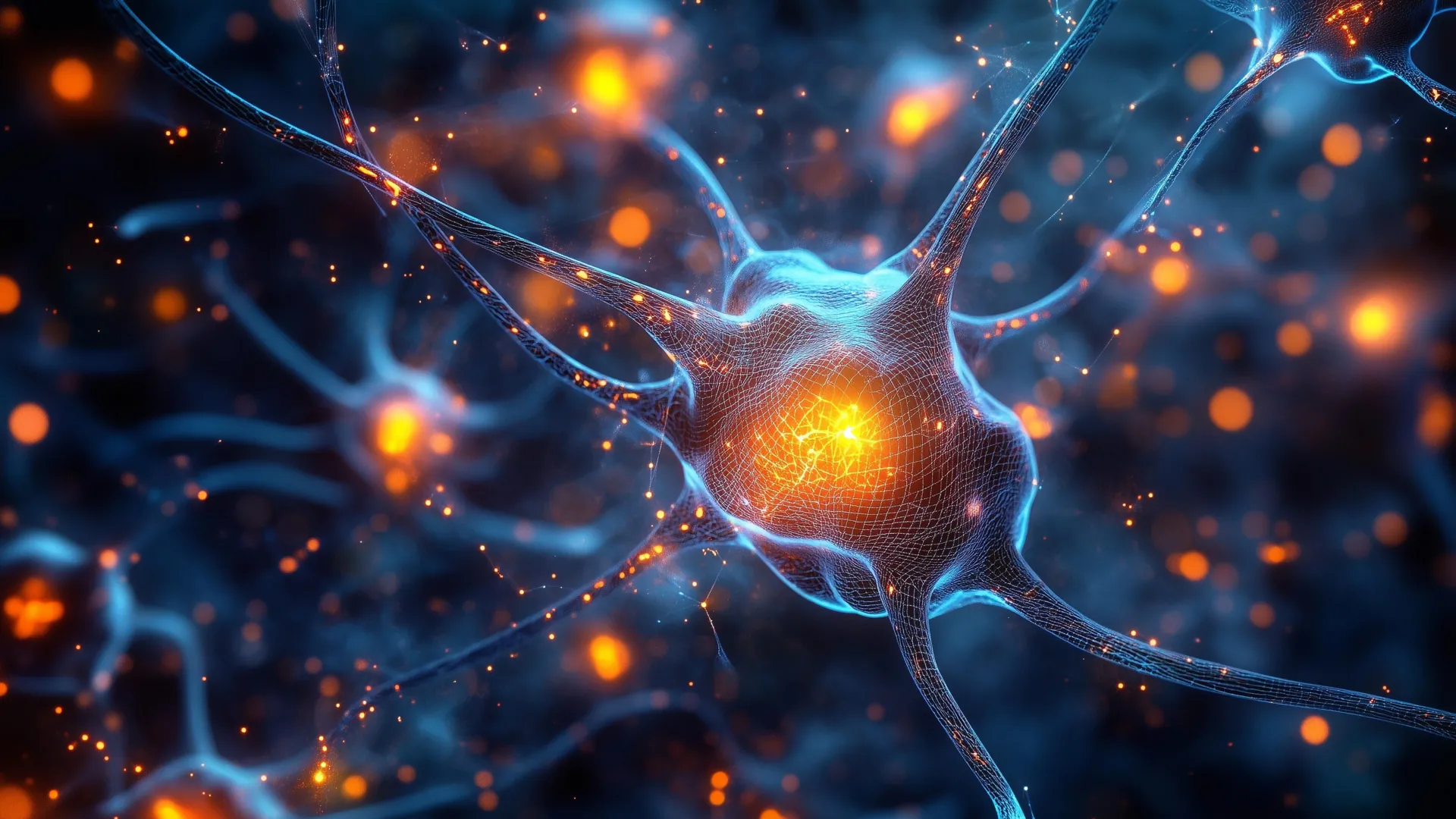
Brain cells continually pull material from the fluid around them, including nutrients, signaling molecules, and fragments of their own outer surfaces. This process, called endocytosis, supports learning, memory, and the routine maintenance of neurons.
Penn State researchers have now identified a previously unrecognized structure that may control much of this activity. The structure is a lattice located just beneath the surface of neurons and is known as the membrane-associated periodic skeleton, or MPS.
A Hidden Gatekeeper Inside Neurons
In findings published in Science Advances, the team showed that the MPS acts as a physical gatekeeper for nearly every major type of endocytosis. Built from repeating rings of proteins, the structure was already known to help neurons retain their shape. The new results indicate that it also plays a much more active role by controlling where and when substances enter the cell.
"For many, many years we have been trying to understand this molecular mechanism, what kind of machinery will help to facilitate this process, because it's connected to neurodegenerative diseases," said Ruobo Zhou, assistant professor of chemistry, of biochemistry and molecular biology, and of biomedical engineering, at Penn State and corresponding author on the study. "When endocytosis -- this nutrient uptake and regulation -- goes wrong, then there's protein aggregation that will build up in the brain, which is the hallmark of neurodegenerative diseases such as Alzheimer's and Parkinson's."
Zhou helped discover the MPS in 2013 while working as a postdoctoral researcher on a Harvard team. At the time, scientists believed the structure mainly served as a passive internal support system. In the new study, Zhou and colleagues used super-resolution imaging on neurons grown in the laboratory and found that the MPS behaves more like a cellular traffic controller, regulating all major forms of endocytosis.
Watching Cellular Uptake at the Nanoscale
The researchers relied on advanced super-resolution microscopy, which can reveal structures at the nanoscale -- about 10,000 times smaller than the thickness of a human hair. They studied neurons grown in petri dishes and caused selected proteins to form inside the cells so those proteins could be tracked.
The scientists then exposed the neurons to different molecules and observed how the cells absorbed them while the MPS remained intact. They also altered the structure by damaging or protecting specific sections, allowing them to see how neurons responded when the lattice changed.
When the MPS was disrupted, the neurons began absorbing material much faster. This indicated that the lattice normally slows the process and prevents excessive uptake.
The researchers also discovered that the structure can contribute to its own breakdown. Faster endocytosis weakened the lattice and triggered a positive feedback loop. Increased uptake activated molecular signals that directed proteins inside the neurons to cut apart sections of the skeleton. That opened additional entry points and allowed even more nutrients and proteins to enter.
"We discovered that this membrane skeleton is actively regulating the nutrient uptake process of neurons," Zhou said. "You can think of it as a gatekeeper, guarding this physical barrier to not allow nutrient uptake to happen. When a neuron needs to take in a specific nutrient, this gatekeeper will open the gates and let it in."
Zhou explained that this flexibility may allow neurons to increase their activity when they need to respond quickly. However, the same mechanism could become harmful if it is no longer properly controlled.
A Possible Link to Alzheimer's Disease
To investigate that possibility, the researchers created cellular experiments that resembled the early stages of Alzheimer's disease. They caused neurons to produce higher levels of amyloid precursor protein (APP), a key marker associated with the disease.
Weakening the MPS caused neurons to take in APP more rapidly. After entering the cells, APP was cut into amyloid-B42, a toxic fragment strongly associated with Alzheimer's disease. Neurons with a damaged MPS accumulated increasing amounts of this harmful molecule and displayed more markers of cell death.
"We created a model which is very much like Alzheimer's disease and found that in some aging neurons, or neurons under pathologic conditions, the endocytosis of toxic proteins was enhanced, which caused stressing conditions, ultimately leading to neuron deaths," said Jinyu Fei, a graduate student in the chemistry department in Penn State's Eberly College of Science and lead author on the study.
A Potential New Treatment Target
The results suggest that the MPS may act as a protective barrier in neurons by slowing APP uptake and limiting the accumulation of toxic molecules. Because the structure is known to deteriorate during aging and neurodegenerative disease, its breakdown could push neurons into a damaging cycle involving greater amyloid production, further structural weakening, and eventual cell death.
The researchers said that protecting or stabilizing this lattice may offer a new way to slow neurodegeneration.
"We think this could open the door for future therapies such as a protein target for neurodegenerative disease treatment," Fei said. "Preserving or stabilizing the MPS might offer a way to slow the early, hidden cellular changes that precede Alzheimer's symptoms."
Other authors on the paper are Yuanmin Zheng, doctoral candidate in biomedical engineering; Caden LaLonde, fourth-year undergraduate student majoring in biochemistry and molecular biology; and Yuan Tao, graduate student at Penn State's Huck Institutes of Life Sciences.
The National Institutes of Health funded this work.
Story Source:
Materials provided by Penn State. Note: Content may be edited for style and length.
Journal Reference:
- Jinyu Fei, Yuanmin Zheng, Caden LaLonde, Yuan Tao, Ruobo Zhou. Membrane-associated periodic skeleton regulates major forms of endocytosis in neurons through a signaling-driven positive feedback loop. Science Advances, 2026; 12 (7) DOI: 10.1126/sciadv.aeb0803
Cite This Page: