
NASA selects four new Moon missions to build a permanent lunar base
- Date:
- July 14, 2026
- Source:
- NASA
- Summary:
- NASA is ramping up its lunar ambitions by awarding nearly $600 million for four commercial Moon landings planned for late 2028. Each mission will carry the same trio of science instruments to improve lunar navigation, study dangerous dust kicked up during landings, and map the Moon's radiation environment. The agency also revealed plans for new rovers, communication satellites, and additional cargo missions as it lays the groundwork for a permanent Moon Base.
- Share:
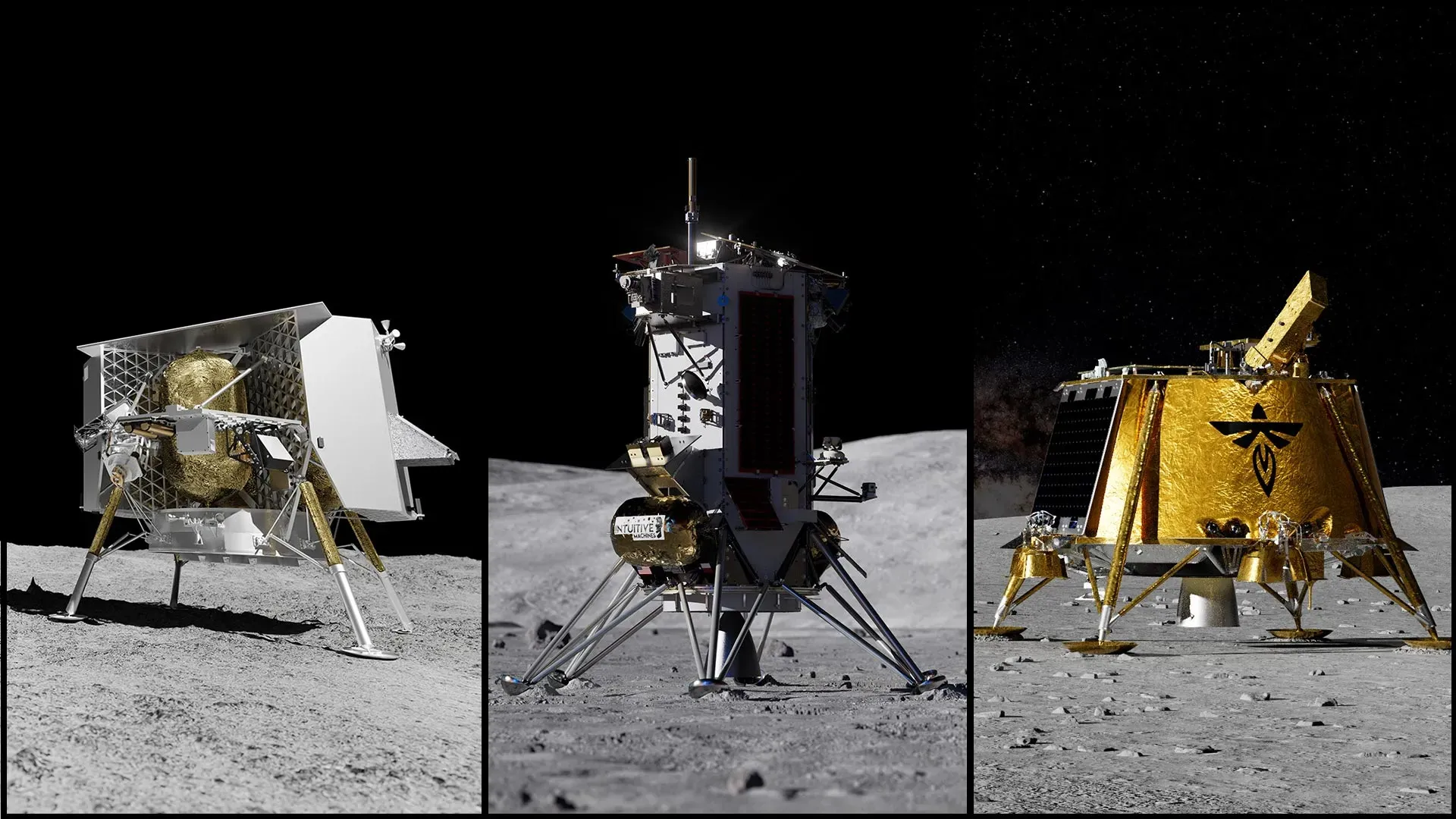
NASA has selected three commercial space companies to carry out four new Moon missions in late 2028, marking another major step in the agency's effort to establish a permanent human presence on the lunar surface. Astrobotic, Firefly Aerospace, and Intuitive Machines will deliver scientific instruments to the Moon as part of NASA's growing Moon Base Program, which aims to create the first long-term outpost on another world.
"These new awards to our commercial partners, totaling nearly $600 million to land more missions on the Moon with science payloads, demonstrate our commitment to accelerating our effort to build a long-term presence on the lunar surface, and give us more opportunity to develop the skills we need to prosper there," said Lori Glaze, associate administrator for the Human Spaceflight Mission Directorate at NASA Headquarters in Washington.
Nearly $600 Million Awarded for Four Lunar Missions
The contracts total almost $600 million across the three companies. Astrobotic received $297.9 million to complete two deliveries, while Firefly Aerospace was awarded $144.2 million and Intuitive Machines received $148.3 million for one mission each.
All four flights will be carried out under NASA's CLPS (Commercial Lunar Payload Services) initiative, which serves as a key transportation system for the Moon Base. Each company will fly upgraded versions of landers that have already been used on previous missions, allowing NASA to increase the pace of lunar exploration.
"We're building a proving ground for Moon Base operations," said Ryan Stephan, NASA's Moon Base acting director of cargo landers. "Accelerating our Moon mission ordering cadence and launch opportunities enable us to move quickly to learn, iterate, and improve."
New Opportunities for Moon Base Development
NASA currently has 17 lunar surface deliveries planned through multiple commercial providers. Alongside the new mission awards, the agency also announced several additional opportunities for US industry to contribute to future Moon Base infrastructure.
One proposal under consideration involves sending PROMISE (Polar Rover for Observation, Mapping, and In-Situ Exploration) to the Moon. The vehicle is a hybrid engineering development version of the Mars Perseverance and Curiosity rovers. If approved, PROMISE would study both the lunar surface and subsurface while searching for useful resources that could support future exploration.
NASA also plans to seek proposals for additional lunar landers that would transport a power and avionics technology demonstration, another collection of scientific instruments, and a South Pole optical imager. The agency will also issue an open solicitation for Moon Base technology demonstrations and begin pursuing a lunar communication and navigation relay constellation to improve communications between infrastructure on the Moon and Earth.
Building the Infrastructure for Future Lunar Exploration
The awards announced on June 30 are intended to strengthen the infrastructure needed for sustained operations on the Moon. Each company will manage procurement activities, evaluate comparable previous lunar landers, and apply lessons learned to improve mission reliability.
Every mission will carry the same three NASA science payloads, allowing researchers to gather comparable measurements from multiple landing sites.
SCALPSS Will Study Lunar Dust During Landing
The Stereo Camera for Lunar Plume Surface Studies (SCALPSS) consists of four cameras that use stereo photogrammetry to create detailed 3D images of how a lander's engine exhaust disturbs lunar dust during descent.
By collecting observations from different landers, engine types, propellants, and landing locations, scientists hope to improve computer models that predict dust erosion and debris movement. This information will become increasingly important as larger spacecraft and heavier equipment begin landing near one another on the Moon.
Laser Retroreflectors Will Improve Lunar Navigation
The Laser Retroreflector Array (LRA) is a passive navigation device that reflects laser beams from orbiting spacecraft or incoming landers, allowing them to determine their position more accurately.
About the size of a cookie, each array contains eight quartz corner cube prisms mounted inside a dome shaped aluminum frame. Because it requires no electrical power or maintenance, the instrument can remain on the lunar surface as a permanent location marker. Similar arrays have already flown aboard previous CLPS missions and international lunar landers, and NASA plans to expand this network over time.
Radiation Monitor Will Help Protect Future Astronauts
The Linear Energy Transfer Spectrometer (LETS) will measure the Moon's radiation environment at different landing sites and during various approaches to the lunar surface.
Built using proven hardware, the instrument relies on a compact silicon detector to measure the energy carried by incoming space radiation. The data will help scientists better understand both the intensity and types of radiation astronauts may encounter, supporting the design of safer spacecraft and future long duration missions.
NASA is also evaluating whether these landers can carry additional payloads beyond the three standard science instruments.
"By flying the same science instruments on multiple landers, we will better understand potential hazards during landing and build out a global network of environmental data and location markers on the Moon," said Joel Kearns, deputy associate administrator for exploration, Science Mission Directorate, NASA Headquarters. "It's akin to having weather stations in different locations on Earth. These three payloads are flight-proven and their data is critical to supporting safe human exploration of the lunar surface."
Preparing for a Permanent Moon Base and Future Mars Missions
NASA continues to expand the Moon Base as a long-term initiative focused on establishing a sustained human presence on the Moon while supporting scientific research and commercial activity.
As part of the Golden Age of innovation and exploration, the agency plans to send astronauts on increasingly ambitious lunar missions that will advance scientific discovery, generate economic opportunities, and help prepare for the first crewed missions to Mars.
Cite This Page: