
Hidden earthquake faults beneath Seattle may be more dangerous than expected
Seattle may be sitting atop a surprisingly active web of hidden earthquake faults.
- Date:
- May 19, 2026
- Source:
- Geological Society of America
- Summary:
- A hidden network of earthquake faults running beneath Seattle may be far more active than scientists realized. New research reveals that smaller “secondary” faults in the Seattle Fault Zone appear to rupture roughly every 350 years — much more often than the massive main fault that has long worried geologists.
- Share:
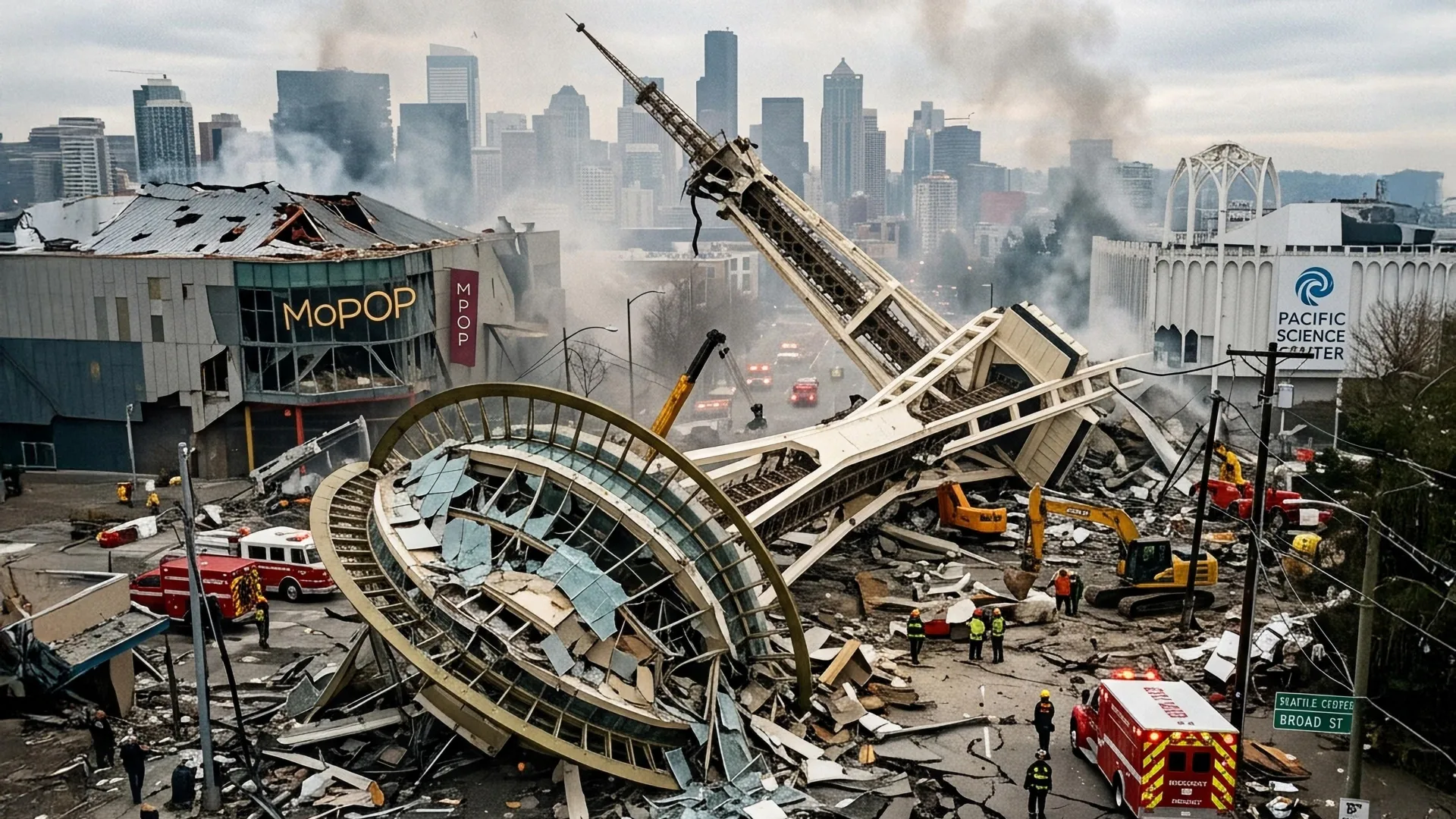
Seattle is best known for the earthquake danger posed by the massive Cascadia subduction zone offshore. But researchers say another threat lies much closer to the city itself. A new study published in GSA Bulletin examines a complicated system of faults running directly beneath Seattle and nearby communities, revealing that smaller faults in the region may be far more active than previously understood.
"My job as a paleoseismologist," says Dr. Stephen Angster, a research geologist at the U.S. Geological Survey's Earthquake Science Center in Seattle and lead author of the new study, "is to figure out when and how often these local faults rupture, which would help us predict roughly when we come in the window of the next potential rupture."
Hidden Faults Beneath Seattle
The research centers on the Seattle Fault Zone (SFZ), an east to west fault system that stretches through Bainbridge Island and Seattle. Scientists have long known that the main Seattle fault produces major earthquakes only over very long periods, typically more than 5,000 years apart. More recently, however, geologists have identified a number of smaller secondary faults connected to the system.
These shorter faults are not usually included in national earthquake hazard calculations because they are considered too small to produce very large earthquakes. Angster says that may overlook an important source of danger.
"When we generate the National Seismic Hazard Model for the U.S., we leave out these shorter faults because they don't meet the minimum requirement for length and thus are considered to have a low magnitude potential," says Angster. "In the case of the SFZ, we don't fully understand the rupture dynamics at depth, but they're rupturing more frequently and pretty close to home."
Why the Seattle Fault Zone Matters
The Seattle Fault Zone helps absorb strain caused by compression in the Earth's crust between Portland, Oregon, and Vancouver, British Columbia. Stress constantly builds in the region and is periodically released through earthquakes. Researchers estimate the SFZ accounts for roughly 15% of the total strain across the Pacific Northwest.
Studying the fault system is challenging because most of the faults are hidden underground and cannot be directly observed at the surface. To investigate them, scientists rely on indirect techniques that reveal clues beneath the landscape.
Researchers use magnetic surveys to detect subtle changes in the underlying bedrock. They also analyze detailed lidar images that can penetrate dense forest cover and expose scarps left behind by ancient earthquakes. These scarps form when the ground shifts during a fault rupture.
To learn when those earthquakes occurred, scientists dig trenches across the scarps and study the displaced layers of soil and sediment.
Evidence of Frequent Earthquakes
Using these methods, Angster and his colleagues reconstructed the history of two newly identified secondary faults within the Seattle Fault Zone. Their findings suggest these smaller faults rupture roughly every 350 years, far more frequently than the main fault itself.
"The surface ruptures from earthquakes within the SFZ have been dominated within the last 2500 years by these secondary fault events," says Angster.
The most recent rupture likely occurred during the nineteenth century. Researchers determined the timing using radiocarbon dating and tree ring evidence from trees that died following an earthquake.
A Growing Concern for Seattle
The team hopes future work will provide a clearer picture of how dangerous these secondary faults may be for the Seattle metropolitan region, home to roughly four million people.
"The thing about the Seattle fault is that in the Cascadia event, we'll shake pretty hard and long when it happens," says Angster, "but it's likely not going to be as destructive for Seattle as a major event on the Seattle fault. I think we're still trying to wrap our heads around the size and the potential of these smaller faults and the relationship between main fault rupture and these more frequent, smaller ruptures."
Story Source:
Materials provided by Geological Society of America. Original written by Rudy Molinek. Note: Content may be edited for style and length.
Journal Reference:
- Stephen J. Angster, Brian L. Sherrod, Jessie K. Pearl, Lydia M. Staisch, Wes Johns, Richard J. Blakely. Latest Pleistocene to nineteenth-century earthquakes on bending-moment reverse faults of the Seattle fault zone, Washington. Geological Society of America Bulletin, 2026; DOI: 10.1130/B38333.1
Cite This Page: