
A legendary golden fabric lost for 2,000 years has been brought back
- Date:
- February 9, 2026
- Source:
- Pohang University of Science & Technology (POSTECH)
- Summary:
- A legendary golden fabric once worn only by emperors has made an astonishing comeback. Korean scientists have successfully recreated ancient sea silk—a rare, shimmering fiber prized since Roman times—using a humble clam farmed in modern coastal waters. Beyond reviving its luxurious look, the team uncovered why this fiber never fades: its glow comes not from dyes, but from microscopic structures that bend light itself.
- Share:
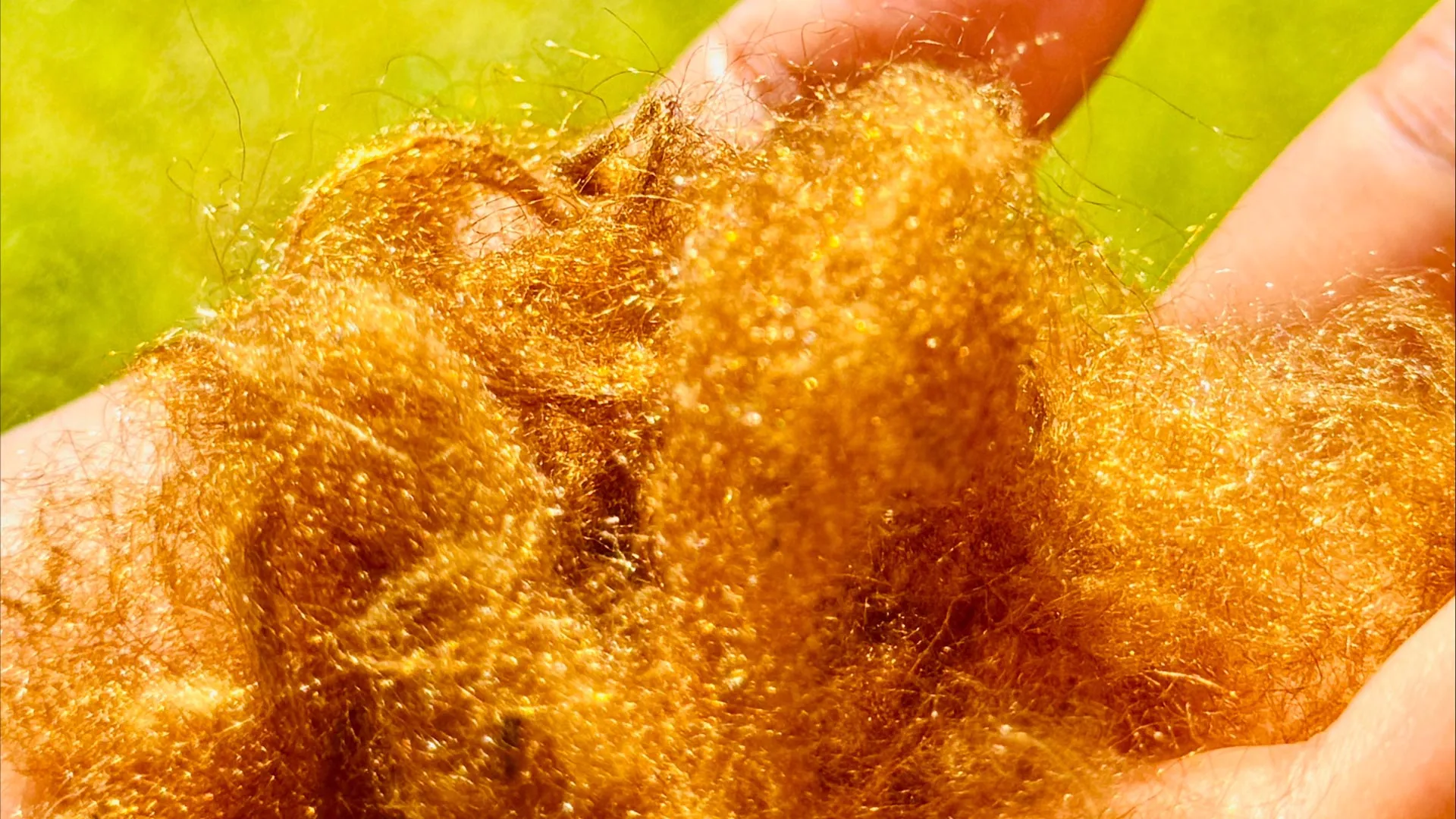
A rare luxury material once worn only by emperors in ancient times has been successfully recreated by scientists in South Korea. Researchers led by Professor Dong Soo Hwang (Division of Environmental Science and Engineering / Division of interdisciplinary bioscience & bioengineering, POSTECH) and Professor Jimin Choi (Environmental Research Institute) have reproduced a shimmering golden fiber similar to one used more than 2,000 years ago. Their work relied on the pen shell (Atrina pectinata), a clam farmed in Korean coastal waters. Along with recreating the fabric known as sea silk, the team uncovered the scientific reason behind its long-lasting golden color. The findings were recently published in the journal Advanced Materials.
Sea silk -- often referred to as the "golden fiber of the sea" -- was among the most treasured materials of the ancient Roman era. It was reserved for powerful figures such as emperors and popes. The fiber comes from byssus threads produced by Pinna nobilis, a large Mediterranean clam that uses these threads to attach itself to rocks. Sea silk became famous for its luminous gold appearance, light weight, and remarkable strength, earning the nickname "legendary silk." One well-known example is the Holy Face of Manoppello, a centuries-old religious relic in Italy believed to be made from this rare material.
Why Traditional Sea Silk Nearly Disappeared
Over time, marine pollution and environmental damage have severely affected Pinna nobilis populations, pushing the species toward extinction. As a result, the European Union has completely banned harvesting the clam. This has turned sea silk into a historical artifact rather than a living craft, with only tiny amounts produced today by a small number of artisans.
To overcome this limitation, the POSTECH team focused on Atrina pectinata, a pen shell commonly raised for food in Korea. Like Pinna nobilis, this species produces byssus threads to anchor itself. The researchers discovered that the byssus from Atrina pectinata closely matches the physical and chemical properties of the original sea silk fibers. Using this knowledge, they developed a method to process the pen shell threads and recreate sea silk.
The Real Secret Behind Sea Silk's Golden Glow
The achievement did not stop at reproducing the fabric's appearance. The researchers also identified why sea silk maintains its golden shine for centuries. The color does not come from dyes. Instead, it results from structural coloration, which occurs when light interacts with tiny structures at the nanoscale.
The team found that sea silk's iridescence is created by a spherical protein structure known as "photonin." These proteins form layered arrangements that reflect light in a way similar to soap bubbles or butterfly wings. Because the color comes from structure rather than pigment, it remains stable and resists fading over long periods of time.
Why the Color Lasts for Thousands of Years
The study also showed that color intensity depends on how neatly the proteins are arranged. The more ordered the structure, the brighter and richer the golden appearance becomes. Unlike traditional fabrics, where color is applied externally, sea silk's color emerges naturally from the internal alignment of its proteins. This explains its extraordinary resistance to fading across centuries.
From Marine Waste to Sustainable Luxury
Another key outcome of the research is the transformation of pen shell byssus, which was previously discarded as waste, into a valuable textile. This approach reduces marine waste while opening the door to sustainable materials that also carry deep cultural and historical meaning.
Professor Dong Soo Hwang noted, "Structurally colored textiles are inherently resistant to fading. Our technology enables long-lasting color without the use of dyes or metals, opening new possibilities for sustainable fashion and advanced materials."
Journal Reference:
- Jimin Choi, Jun‐Hyung Im, Young‐Ki Kim, Tae Joo Shin, Patrick Flammang, Gi‐Ra Yi, David J. Pine, Dong Soo Hwang. Structurally Colored Sustainable Sea Silk from Atrina pectinata. Advanced Materials, 2025; 37 (30) DOI: 10.1002/adma.202502820
Cite This Page: