
Buried Roman sanctuary discovered beneath Frankfurt hints at shocking rituals
A buried Roman cult complex in Frankfurt may reveal shocking rituals—and rewrite what we know about ancient religion.
- Date:
- April 5, 2026
- Source:
- Goethe University Frankfurt
- Summary:
- A hidden Roman sanctuary discovered beneath Frankfurt is offering rare clues about ancient rituals, including possible human sacrifice. With major funding secured, scientists are now racing to uncover how this mysterious, multi-god cult site operated.
- Share:
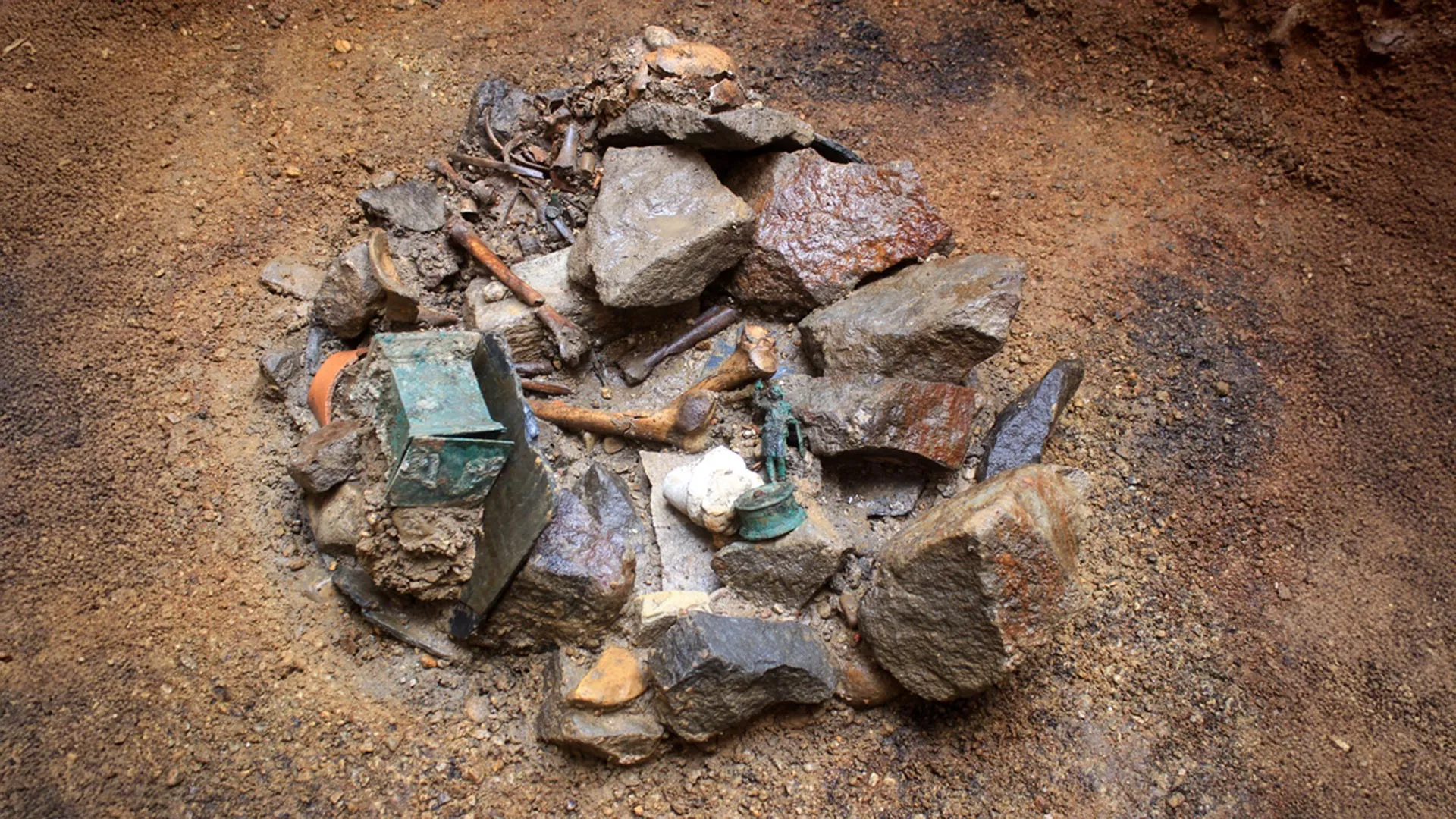
A major new research effort is set to shed light on a remarkable Roman discovery in Frankfurt, Germany. The German Research Foundation (DFG) and the Swiss National Science Foundation (SNF) have jointly awarded more than €1 million to support the study of a large Roman sanctuary in the ancient city of Nida (Frankfurt-Heddernheim). Over the next three years, researchers will carry out an in-depth investigation of what is considered one of the most important recent finds from Roman Germania.
The project, titled "Exploring the dynamics of a Roman sanctuary -- Interdisciplinary studies on spatial organisation and depositions at the central sanctuary in Nida-Heddernheim," brings together experts from several institutions. Participants include the Archaeological Museum Frankfurt (Dr. Carsten Wenzel); the Institute for Archaeological Sciences at Goethe University Frankfurt (Prof. Anja Klöckner, Classical Archaeology; Prof. Markus Scholz, Archaeology and History of the Roman Provinces; Prof. Astrid Stobbe, Archaeobotany); and the Institute for Integrative Prehistoric and Scientific Archaeology (IPNA) at the University of Basel (Prof. Sabine Deschler-Erb (ⴕ), Dr. Barbara Stopp). Additional partners include Frankfurt's City Monument Office [Denkmalamt] and the Roman-Germanic Commission (RGK) of the German Archaeological Institute.
The initiative was formally introduced at a press conference at the Archaeological Museum of Frankfurt.
Dr. Ina Hartwig, Frankfurt's City Commissioner for Culture and Science, highlighted the importance of the discovery: "The central cult district of Nida represents an archaeological discovery of almost unparalleled significance in Europe. Its comprehensive scholarly investigation will further establish Frankfurt as a hub of international cutting-edge research. The project demonstrates the strength of our research landscape when museums, universities, non-university research institutions, and heritage conservation work hand in hand to make research visible within the city."
Roman Cult Complex Discovered During School Construction
The sanctuary came to light during excavations carried out by the Monument Office between 2016 and 2018, and again in 2022, in Frankfurt's Nordweststadt district. The work took place during construction of the new "Römerstadtschule," where archaeologists excavated more than 4,500 square meters at the center of the ancient Roman city.
The dig revealed a walled complex that had remained largely undisturbed since Roman times. The site was almost entirely excavated and carefully recorded using modern archaeological techniques, preserving a clear picture of its original layout.
Marcus Gwechenberger, Frankfurt's City Councilor for Planning and Housing, emphasized the importance of the find: "The newly uncovered cult district of the Roman city of Nida is among the most important archaeological finds in Frankfurt in recent years. The funding now makes it possible to scientifically analyze this exceptional discovery in depth. At the same time, it recognizes the continuous and highly professional work of our municipal heritage office. This project also illustrates how urban development and research go hand in hand in Frankfurt. The fact that the discovery was made during construction of the new Römerstadtschule vividly demonstrates how past and future intersect in our city."
Evidence of Ritual Activity and Offerings
The sanctuary includes eleven stone buildings constructed over several phases, along with about 70 shafts and ten pits used for (ritual) depositions. The layout of the buildings is highly unusual, with no known parallels in the Roman provinces of Germania or Gaul.
Archaeologists uncovered more than 5,000 fragments of painted wall plaster, along with bronze fittings from doors and windows, pointing to richly decorated structures. The shafts and pits contained ceramic vessels and large quantities of plant and animal remains, including fish and birds. These materials are believed to be the remains of ritual meals and offerings made to the gods. Researchers collected 150 samples for detailed archaeozoological and archaeobotanical analysis.
Further insight comes from 254 Roman coins and more than 70 silver and bronze garment clasps (fibulae), some still intact. These objects are commonly associated with offerings in Roman religious sites. However, researchers have also identified evidence that may point to human sacrifice, a finding that would be extremely rare for this region.
Despite the abundance of material, it remains difficult to determine exactly which deities were worshipped. Inscriptions and imagery suggest the presence of several gods, including Jupiter, Jupiter Dolichenus, Mercurius Alatheus, Diana, Apollo, and Epona. This mix indicates that the sanctuary likely served as an important regional center where multiple deities were honored.
Current evidence suggests the site was established in the early 2nd century CE. A dedication from a soldier to Mercurius Alatheus, dated September 9, 246 CE, shows that the sanctuary remained active at least into the mid-3rd century CE.
New Research Aims to Reconstruct Roman Ritual Life
The newly approved funding highlights the growing importance of archaeological research in the Frankfurt region and reflects strong collaboration among institutions in the Rhine-Main area and beyond.
By combining multiple scientific approaches, the research team aims to better understand how the sanctuary was used. The focus will be on analyzing the layout of the buildings and the patterns of deposited materials to reconstruct the rituals that once took place there. The project will also place the Nida sanctuary within the wider context of religious landscapes across the northwestern Roman provinces. Five early-career researchers will take part in the project as part of doctoral and postdoctoral programs.
Nida's Broader Significance in Roman History
The new study builds on decades of previous excavations in Nida, which have already revealed important details about the city's development and layout. Just over a year after the unveiling of the "Frankfurt Silver Inscription" -- the oldest known Christian written testimony north of the Alps -- attention is once again turning to this ancient site.
Researchers now have a rare opportunity to explore Roman religious practices in detail, including temples, offerings, and ritual behavior. The exceptional preservation of the site highlights Nida's importance as a key center in Roman Germania.
Founded as a military base in the 70s of the 1st century CE, Nida grew into a major economic and cultural hub by the early 2nd century. Known for its cultural diversity, the city remained one of the most significant urban centers in the region until it was abandoned around 275/280 CE.
Story Source:
Materials provided by Goethe University Frankfurt. Note: Content may be edited for style and length.
Cite This Page: