
These tropical trees breathe at night to survive drought
Scientists discovered how millions of years of genetic reshuffling gave tropical trees a powerful water-saving photosynthesis strategy that could inspire drought-resistant crops.
- Date:
- September 23, 2026
- Source:
- University of Vienna
- Summary:
- Some tropical trees have evolved a clever way to survive drought by taking in carbon dioxide at night, allowing them to keep their pores closed during the hot daytime and conserve water. By comparing three Clusia species, researchers discovered that this water-saving form of photosynthesis, known as CAM, did not arise through a single evolutionary change. Instead, ancient genome duplications followed by millions of years of genetic reshuffling produced strikingly different strategies, from strong CAM to stress-triggered and hybrid forms.
- Share:
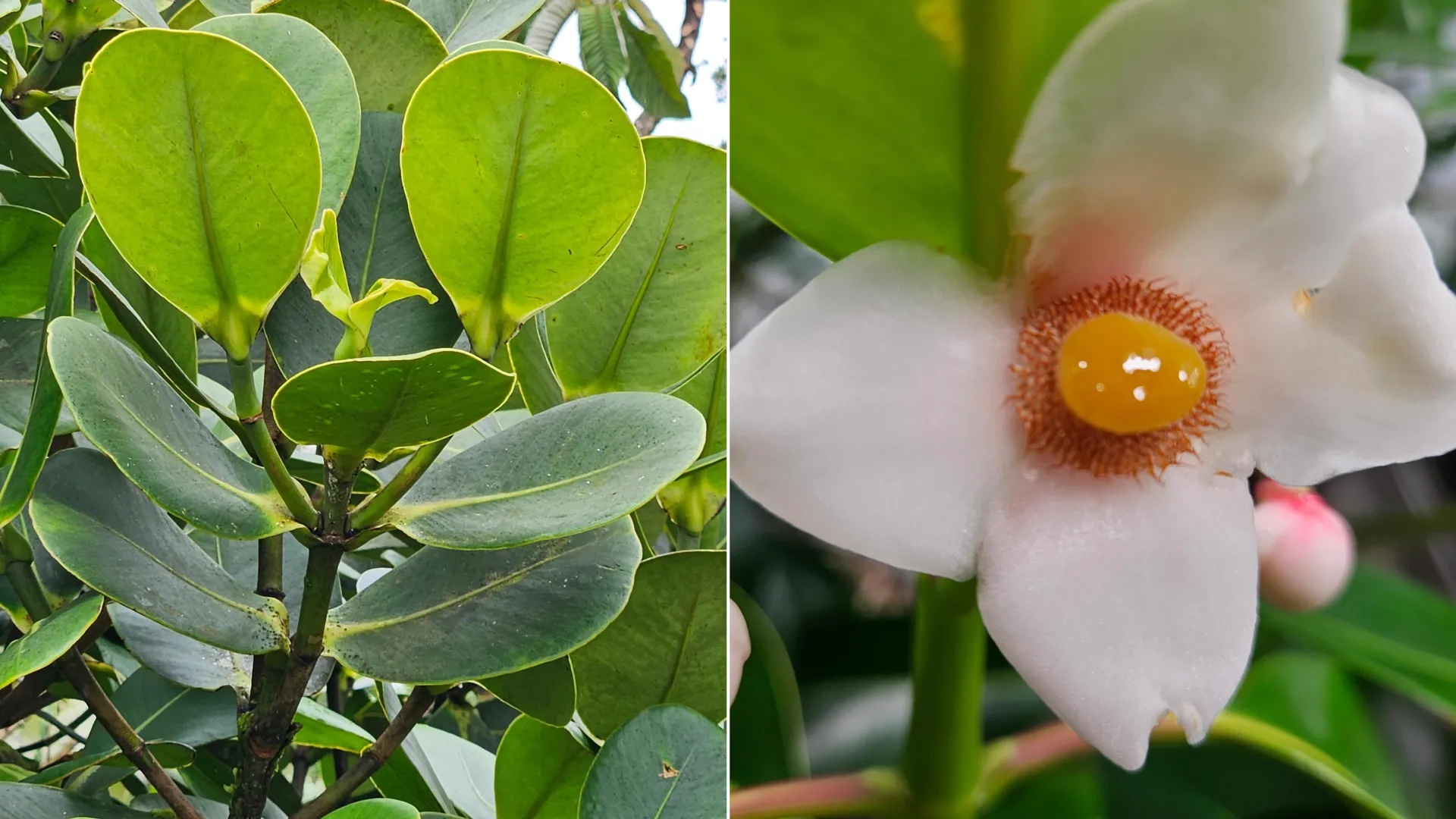
Plants have evolved several ways to use sunlight to turn water and carbon dioxide into energy-rich sugars and oxygen (photosynthesis). But when water becomes scarce, that process can become much more difficult.
Researchers led by Wolfram Weckwerth at the University of Vienna have now uncovered how one especially water efficient form of photosynthesis (CAM) evolved in multiple ways within a single genus of tropical trees. By comparing the genomes of three Clusia species, the team traced how ancient genome duplication followed by extensive genetic reorganization helped produce different forms of CAM. The findings were recently published in Nature Communications.
A Photosynthesis Mystery Dating Back 200 Years
Around 1800, Alexander von Humboldt noticed something unusual while studying a tropical tree. He placed one of its leaves in water and found that, even in sunlight, it did not produce the oxygen bubbles he had observed before.
The explanation lies in the plant's unusual daily schedule. Its stomata, the tiny pores that normally take in CO2 and release oxygen during the day, remain closed while the sun is up, reducing water loss through evaporation. Instead, the plant absorbs CO2 at night, chemically binds it, and stores it as malic acid.
This strategy is known as 'CAM photosynthesis' (Crassulacean Acid Metabolism). Although scientists have long known how CAM works, exactly how it evolved within the genus Clusia, and why different species use it in different ways, has remained unclear.
Comparing Three Tropical Tree Genomes
To investigate, the researchers analyzed the genomes of three Clusia species with different CAM phenotypes: Clusia rosea, Clusia minor, and Clusia major. They combined molecular data with measurements of how the plants functioned under realistic environmental conditions.
The genus Clusia is particularly valuable for studying the evolution of photosynthesis because it contains the only known trees that use CAM. Its species also display an unusually wide range of photosynthetic strategies, from conventional C3 photosynthesis, in which carbon dioxide is absorbed during the day, to very strong CAM.
That diversity gives scientists a rare opportunity to examine how plants can transition between different forms of photosynthesis.
Ancient Genome Duplication Rewired Photosynthesis
The genomic analysis revealed that all three Clusia species are ancient polyploids. At some point in their evolutionary history, their genomes were multiplied (polyploidization). Over long periods, those enlarged genomes were then reorganized and reshaped (diploidization).
"In the process, gene copies are lost, deactivated or take on new functions," explains lead author Hannes Kramml from the Division of Molecular Systems Biology, Department of Functional and Evolutionary Ecology, at the University of Vienna.
Second lead author Johannes Herpell adds: "Genes crucial for nocturnal CO2 storage in CAM metabolism are particularly affected."
Rather than simply carrying extra copies of the same genes, the plants gradually transformed those duplicated genomes into something different.
"The genomes have not simply multiplied; over millions of years, they have been reorganized, reduced and functionally rewired. This enormous plasticity explains the physiological diversity of CAM in the genus Clusia," study leader Wolfram Weckwerth explains.
Different Trees Use CAM in Different Ways
The researchers then examined how those genetic differences affected the plants themselves. They monitored the trees throughout the day in near natural greenhouse conditions while varying the amount of water available.
The team combined measurements of plant physiology with analyses of gene activity, proteins and metabolic products.
The three species showed strikingly different approaches. Clusia rosea uses strong CAM and stores substantial amounts of carbon dioxide as malic acid during the night. Clusia minor mainly switches on CAM when it experiences stressful conditions. Clusia major, meanwhile, uses a hybrid strategy combining C3 photosynthesis and CAM.
Those physiological differences were also visible in patterns of gene activity and metabolism, allowing the researchers to connect the plants' behavior with the genomic changes they identified.
The findings suggest that CAM within Clusia was not produced by a single evolutionary event. Instead, repeated rounds of genomic reorganization appear to have generated different versions of the water saving strategy, helping individual species adapt to very different ecological niches.
Clues for More Drought-Resistant Crops
The results could eventually have implications beyond tropical trees.
CAM plants need substantially less water than plants relying entirely on more conventional forms of photosynthesis, making them potentially useful models for developing climate resilient crops.
The newly available genomic information could help researchers identify metabolic processes involved in efficient CO2 fixation and high water use efficiency. Over the longer term, that knowledge may help scientists develop crops that are better adapted to arid environmental conditions.
Story Source:
Materials provided by University of Vienna. Note: Content may be edited for style and length.
Journal Reference:
- Hannes M. Kramml, Johannes B. Herpell, Clara Priemer, Zoe Wessely, Florian Schindler, Andreas Berger, Maximilian Kellner, Stefan Plott, Ágnes Dohovits, Tamara Schmidt, Peter Kerpan, Leila Afjehi-Sadat, Palak Chaturvedi, Arindam Ghatak, Martin Brenner, Iro Pierides, Lena Fragner, Eva M. Temsch, Fabio Trevisan, Menriti Ibrahim, Felix Fromwald, Anke Bellaire, Oleg Simakov, Werner Huber, Ulrich Lüttge, Ovidiu Paun, Susann Wicke, Hanna Weiss-Schneeweiss, Gert Bachmann, Wolfram Weckwerth. Clusia genomes shed light on the evolution and diversity of crassulacean acid metabolism physiotypes. Nature Communications, 2026; 17 (1) DOI: 10.1038/s41467-026-71958-z
Cite This Page: