
Scientists discover bacteria can “explode” to spread antibiotic resistance
Bacteria are hijacking their own “immune system” to burst open and share DNA—fueling the spread of antibiotic resistance.
- Date:
- April 17, 2026
- Source:
- John Innes Centre
- Summary:
- Scientists have uncovered a surprising twist in how bacteria share genes—including those that spread antibiotic resistance. Tiny virus-like particles called gene transfer agents (GTAs), once ancient viral invaders, have been repurposed by bacteria into delivery systems that shuttle DNA between neighboring cells. The study reveals a key control hub of three genes, dubbed LypABC, that triggers bacterial cells to burst open and release these DNA-packed couriers.
- Share:
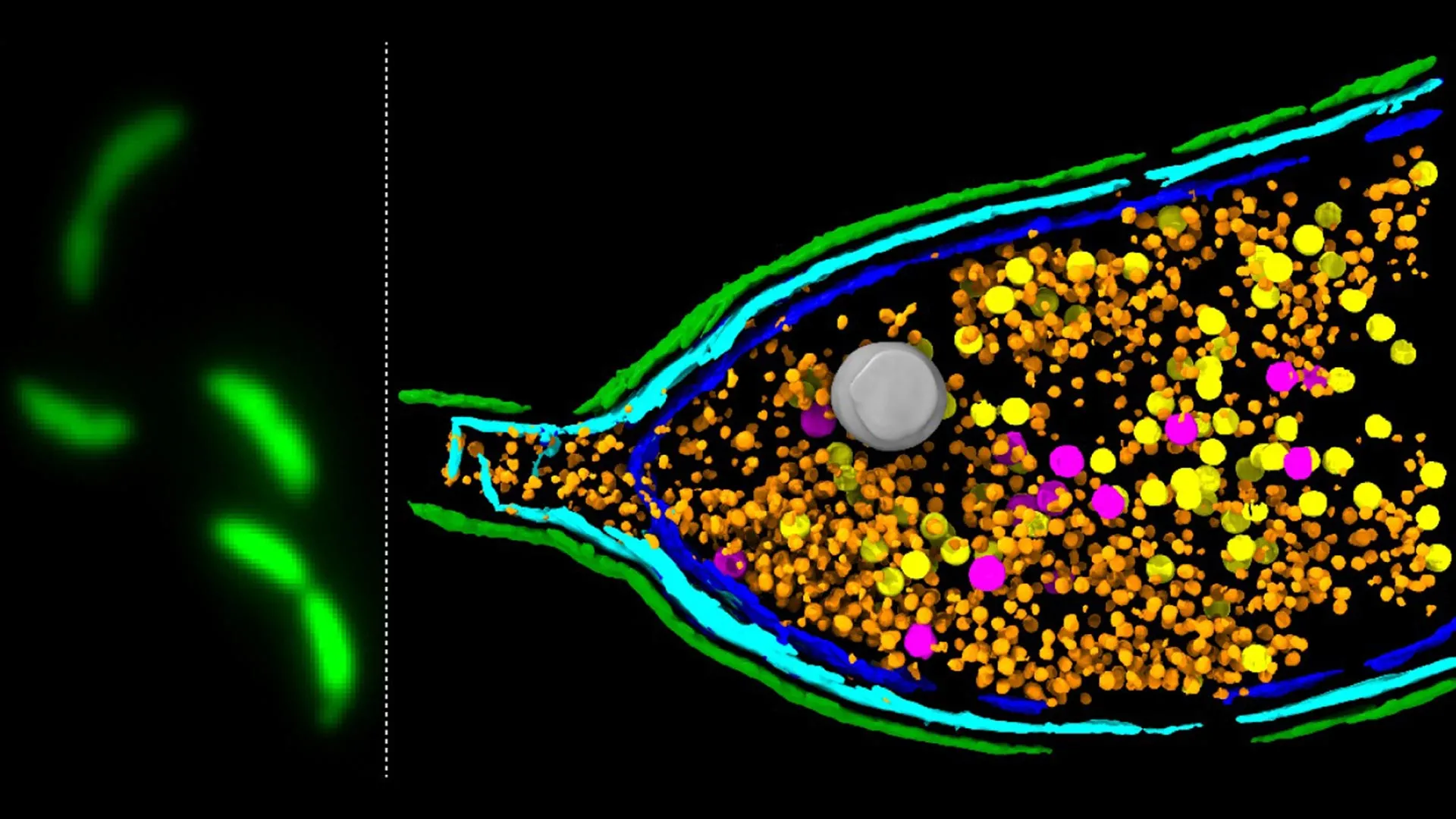
Scientists have uncovered new details about how bacteria share genes, including those that drive antimicrobial resistance (AMR), a growing global health threat. The findings come from researchers at the John Innes Centre, who studied unusual particles known as gene transfer agents (GTAs).
GTAs resemble bacteriophages (viruses that infect bacteria), but they are no longer harmful invaders. Instead, they are derived from ancient viruses that bacteria have adapted and brought under their own control.
Virus-Like Particles Deliver DNA Between Cells
These particles act like tiny delivery vehicles. They pick up fragments of DNA from one bacterial cell and carry them to others nearby. This process, called horizontal gene transfer, allows bacteria to quickly share useful traits, including genes that help them survive antibiotic treatments.
A key step in this process is host cell lysis, the breaking open of a bacterial cell so that GTA particles can be released. Until now, scientists did not fully understand how these particles escaped from their host cells.
Key Gene Cluster Controls Cell Lysis
In research published in Nature Microbiology, the team used a deep sequencing-based screening method to pinpoint the genes involved in GTA activity in the model bacterium Caulobacter crescentus.
They identified a three-gene system called LypABC, which produces bacterial proteins. When the lypABC genes were removed, cells could no longer break open to release GTA particles. When the system was overactivated, many cells underwent lysis. These results show that LypABC acts as a central control hub for this process.
An Immune System Repurposed for Gene Transfer
One of the most surprising findings is that LypABC closely resembles a bacterial anti-phage immune system. It contains protein components usually associated with defense against viruses. However, in this case, the system appears to have been repurposed to help release GTA particles and promote gene transfer.
This work, carried out in collaboration with the University of York and the Rowland Institute at Harvard, highlights how bacteria can reuse existing biological systems in unexpected ways.
Tight Regulation Is Essential for Survival
The researchers also discovered a regulatory protein that helps keep GTA activity under strict control. This regulation is critical because improper activation of LypABC can be highly toxic to bacterial cells.
By revealing how flexible bacterial systems can be, the study provides deeper insight into how genes move between cells. This process plays a major role in the spread of antibiotic resistance.
New Clues in the Fight Against Antibiotic Resistance
First author of the study Dr. Emma Banks, a Royal Commission for the Exhibition of 1851 Research Fellow, said: "What's particularly interesting is that LypABC looks like an immune system, yet bacteria are using it to release GTA particles. It suggests that immune systems can be repurposed to help bacteria share DNA with each other -- a process that can contribute to the spread of antibiotic resistance."
The next step is to understand how the LypABC system is activated and how it controls the rupture of bacterial cells to release GTA particles.
Research has shed important new light on the enemies-turned-allies that allow bacteria to exchange genes, including those linked to antimicrobial resistance (AMR).
The insights, which expand our understanding of the major global health threat of AMR, came as John Innes Centre researchers investigated the curious phenomena of gene transfer agents (GTAs).
These gene-carrying particles look like bacteriophages (viruses that infect bacteria), but they have been domesticated from ancient viruses and put to beneficial use under the control of the bacterial host cell.
Acting as couriers, they take up parcels of host bacterial DNA and deliver them to neighbouring bacteria. This "selfless" sharing, known as horizontal gene transfer, can rapidly spread useful traits including genes that confer resistance to antibiotic drugs used to treat infections.
A crucial GTA life stage is host cell lysis: the breaking down of a host cell to release DNA-packed GTA particles. Previously, it was unclear how GTA particles escape their host bacterial cells.
In this study, which appears in Nature Microbiology, the team used a deep sequencing-based screening method to identify genes critical for GTA function in the model bacterium Caulobacter crescentus.
This identified a three-gene control hub, LypABC, encoding bacterial proteins. When these lypABC genes were deleted, bacteria could no longer lyse to release GTA particles. In contrast, by overexpressing the lypABC hub they obtained a very high proportion of lysing cells. Together, these experiments identified LypABC as a control mechanism for GTA-mediated cell lysis.
Surprisingly, LypABC resembles a bacterial anti-phage immune system since it contains protein domains which are typically required for defence against viruses. However, this collaborative effort between the John Innes Centre, the University of York, and the Rowland Institute at Harvard, suggests it has been repurposed to release GTA particles for gene transfer.
They also identified a regulatory protein which is required for strict control of both GTA activation and GTA-mediated lysis. This control is important as misregulation of LypABC is highly toxic to bacterial cells.
In highlighting the plasticity of bacterial domains, the study advances fundamental knowledge of how gene transfer occurs between bacterial cells and offers an important clue to understanding how AMR occurs.
First author of the study Dr. Emma Banks, a Royal Commission for the Exhibition of 1851 Research Fellow, said: "What's particularly interesting is that LypABC looks like an immune system, yet bacteria are using it to release GTA particles. It suggests that immune systems can be repurposed to help bacteria share DNA with each other -- a process that can contribute to the spread of antibiotic resistance."
The next step for the research is to discover how the LypABC control hub is activated and how it functions to control the rupture of bacterial cells and release of GTA particles.
"A bacterial CARD-NLR-like immune system controls the release of gene transfer agents," appears in Nature Microbiology.
Story Source:
Materials provided by John Innes Centre. Note: Content may be edited for style and length.
Journal Reference:
- Emma J. Banks, Pavol Bárdy, Ngat T. Tran, Phuong M. Nguyen, Boris Stojilković, Kevin Gozzi, Abbas Maqbool, Tung B. K. Le. A bacterial CARD–NLR-like immune system controls the release of gene transfer agents. Nature Microbiology, 2026; DOI: 10.1038/s41564-026-02316-4
Cite This Page: