
Scientists were wrong for decades about DNA knots
- Date:
- February 9, 2026
- Source:
- University of Cambridge
- Summary:
- Scientists have discovered that DNA behaves in a surprising way when squeezed through tiny nanopores, overturning a long-held assumption in genetics research. What researchers once thought were knots causing messy electrical signals turn out to be something else entirely: twisted coils called plectonemes, formed as flowing ions inside the pore spin the DNA like a phone cord. These twists can linger and grow as DNA moves through, leaving clear electrical fingerprints.
- Share:
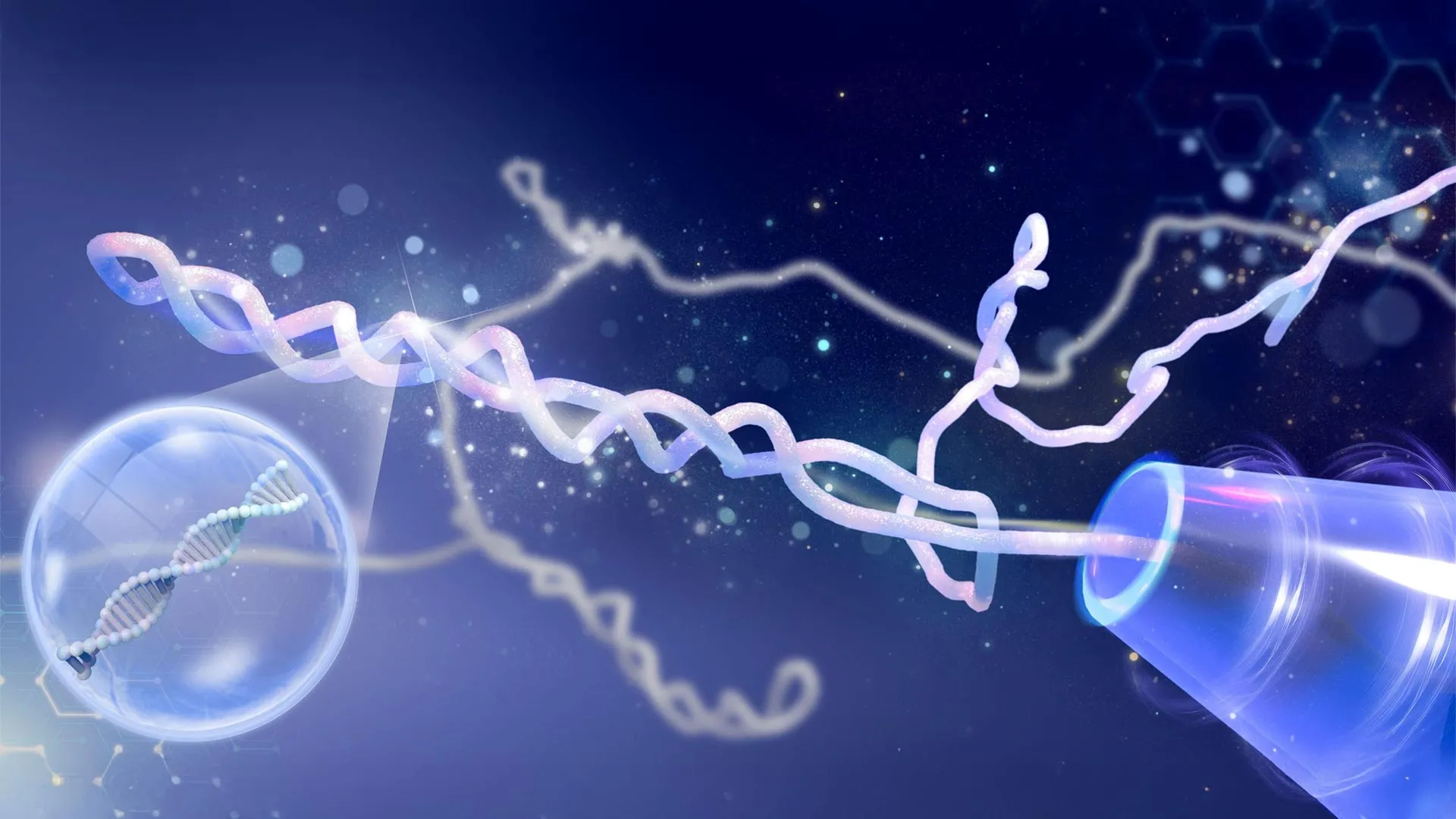
Scientists at the University of Cambridge, working with international collaborators, have identified a crucial process that shapes how DNA behaves as it moves through nanoscale pores. This process is fundamental to many biological activities and to fast-growing DNA sensing technologies. The research highlights a long-overlooked DNA structure called plectonemes, a finding that could influence future advances in genomics and biosensing.
Nanopores are extremely small openings that allow single strands of DNA to pass through while producing electrical signals. These signals help researchers analyze genetic material in detail. Until now, important features of those signals had been misunderstood.
Why Scientists Thought DNA Was Forming Knots
For many years, researchers believed that complex electrical patterns seen during nanopore experiments were caused by DNA forming knots. The idea was easy to picture. Pulling a shoelace through a narrow hole becomes uneven if the lace tangles, and scientists assumed DNA behaved in the same way. Any irregular signal was thought to mean the strand had knotted as it moved through the pore.
That explanation shaped how nanopore data was interpreted for decades.
Twists, Not Knots, Explain the Signals
The new study, published in Physical Review X, shows that this long-standing assumption was often wrong. Instead of forming true knots, DNA frequently twists around itself during nanopore translocation. These twisted structures, known as plectonemes, resemble a coiled phone cord rather than a tied knot.
This distinction matters because twists and knots affect electrical signals in very different ways.
"Our experiments showed that as DNA is pulled through the nanopore, the ionic flow inside twists the strand, accumulating torque and winding it into plectonemes, not just knots. This 'hidden' twisting structure has a distinctive, long-lasting fingerprint in the electrical signal, unlike the more transient signature of knots," explained lead author Dr Fei Zheng from the Cavendish Laboratory.
Experiments Point to a Missing Mechanism
To reach this conclusion, the researchers tested DNA using both glass and silicon nitride nanopores across a wide range of voltages and conditions. They noticed that so-called "tangled" events, when more than one section of DNA occupied the pore at the same time, occurred far more often than knot theory could explain.
These events became even more frequent as voltage increased and as DNA strands grew longer. This pattern suggested that another force was at work.
How Flowing Water Twists DNA
The team found that the twisting comes from electroosmotic flow, the movement of water driven by electric fields inside the nanopore. As water flows past the DNA, it applies a spinning force to the helical molecule. This torque travels along the strand, causing sections outside the pore to coil into plectonemes.
Unlike knots, which tighten under pulling forces and typically disappear quickly, plectonemes can grow larger and remain present throughout the entire translocation process. Computer simulations that applied realistic forces and torques confirmed this behavior and showed that plectoneme formation depends on DNA's ability to transmit twist along its length.
Blocking Twists Confirms the Discovery
To test the idea further, the researchers created "nicked" DNA, strands that were interrupted at specific points. These interruptions prevented twist from spreading along the molecule and sharply reduced the formation of plectonemes during experiments.
This result confirmed that twist propagation is essential to the process. It also hints at new ways nanopores could be used to detect DNA damage, since breaks in the strand interfere with twisting behavior.
Reading DNA Signals With New Precision
"What's really powerful here is that we can now tell apart knots and plectonemes in the nanopore signal based on how long they last," says Prof Ulrich F. Keyser, also from the Cavendish Laboratory and a co-author of the study.
"Knots pass through quickly, just like a quick bump, whereas plectonemes linger and create extended signals. This offers a path to richer, more nuanced readouts of DNA organization, genomic integrity, and possibly damage."
Broader Implications for Biology and Technology
The findings extend beyond nanopore sensing. In living cells, DNA regularly twists and tangles as enzymes act on it, and both knots and plectonemes play important roles in genome organization and stability. Understanding how these structures form could improve models of cellular DNA behavior.
For diagnostics and biosensing, the ability to detect or control DNA twisting could lead to more sensitive tools capable of identifying subtle genetic changes and early signs of DNA damage linked to disease.
"From the perspective of nanotechnology, the research highlights the power of nanopores, not only as sophisticated sensors but also as tools for manipulating biopolymers in novel ways," concluded Keyser.
Story Source:
Materials provided by University of Cambridge. Note: Content may be edited for style and length.
Journal Reference:
- Fei Zheng, Antonio Suma, Christopher Maffeo, Kaikai Chen, Mohammed Alawami, Jingjie Sha, Aleksei Aksimentiev, Cristian Micheletti, Ulrich F. Keyser. Torsion-Driven Plectoneme Formation During Nanopore Translocation of DNA Polymers. Physical Review X, 2025; 15 (3) DOI: 10.1103/spyg-kl86
Cite This Page: