
A strange in-between state of matter is finally observed
When a crystal is just one atom thick, melting gets weird — and scientists have finally caught it on camera.
- Date:
- January 26, 2026
- Source:
- University of Vienna
- Summary:
- When materials become just one atom thick, melting no longer follows the familiar rules. Instead of jumping straight from solid to liquid, an unusual in-between state emerges, where atomic positions loosen like a liquid but still keep some solid-like order. Scientists at the University of Vienna have now captured this elusive “hexatic” phase in real time by filming an ultra-thin silver iodide crystal as it melted inside a protective graphene sandwich.
- Share:
When ice turns into water, the change happens almost instantly. As soon as the temperature reaches the melting point, the rigid structure of ice collapses into liquid water. This rapid switch from solid to liquid is typical for familiar three-dimensional materials.
Extremely thin materials behave very differently. Instead of melting all at once, they can pass through an unusual intermediate state that sits between solid and liquid. This rare condition is known as the hexatic phase. Scientists at the University of Vienna have now directly observed this phase in an atomically thin crystal, something that had never been confirmed before.
By combining advanced electron microscopy with neural networks, the team recorded a silver iodide crystal as it melted while being protected by layers of graphene. These ultra-thin, two-dimensional materials allowed researchers to watch melting unfold at the level of individual atoms. The results greatly improve scientific understanding of how phase transitions work in two dimensions. The findings also contradict long-standing theoretical expectations, and they have now been published in Science.
Why Two-Dimensional Materials Melt Differently
In everyday materials, melting happens abruptly. Once the melting temperature is reached, an orderly solid structure quickly turns into a disordered liquid. This behavior is shared by metals, minerals, ice, and many other three-dimensional substances.
When a material is reduced to nearly two dimensions, however, melting follows a different path. Between the solid and liquid states, a distinct intermediate phase can appear. Known as the hexatic phase, this state was first proposed in the 1970s but remained difficult to confirm in real materials.
In this phase, the material shows mixed behavior. The spacing between particles becomes irregular, similar to a liquid, while the angles between them remain partially ordered, a trait usually associated with solids. This combination makes the hexatic phase a hybrid state with properties of both forms of matter.
Solving a Long-Standing Mystery in Real Materials
Until now, the hexatic phase had only been observed in simplified model systems such as tightly packed polystyrene spheres. Scientists were unsure whether the same behavior could exist in everyday materials held together by strong chemical bonds.
The international research team led by the University of Vienna has now answered that question. By studying atomically thin crystals of silver iodide (AgI), the researchers were able to observe the hexatic phase directly for the first time in a strongly bonded material. This achievement resolves a question that had remained open for decades.
The discovery confirms that this elusive phase can occur in real two-dimensional crystals and reveals new details about how melting works when materials are reduced to atomic thickness.
Melting Atoms Inside a Graphene Sandwich
To observe this fragile process, the researchers designed a specialized experimental setup. A single layer of silver iodide was placed between two sheets of graphene, forming a protective "sandwich." This structure prevented the delicate crystal from collapsing while still allowing it to melt naturally.
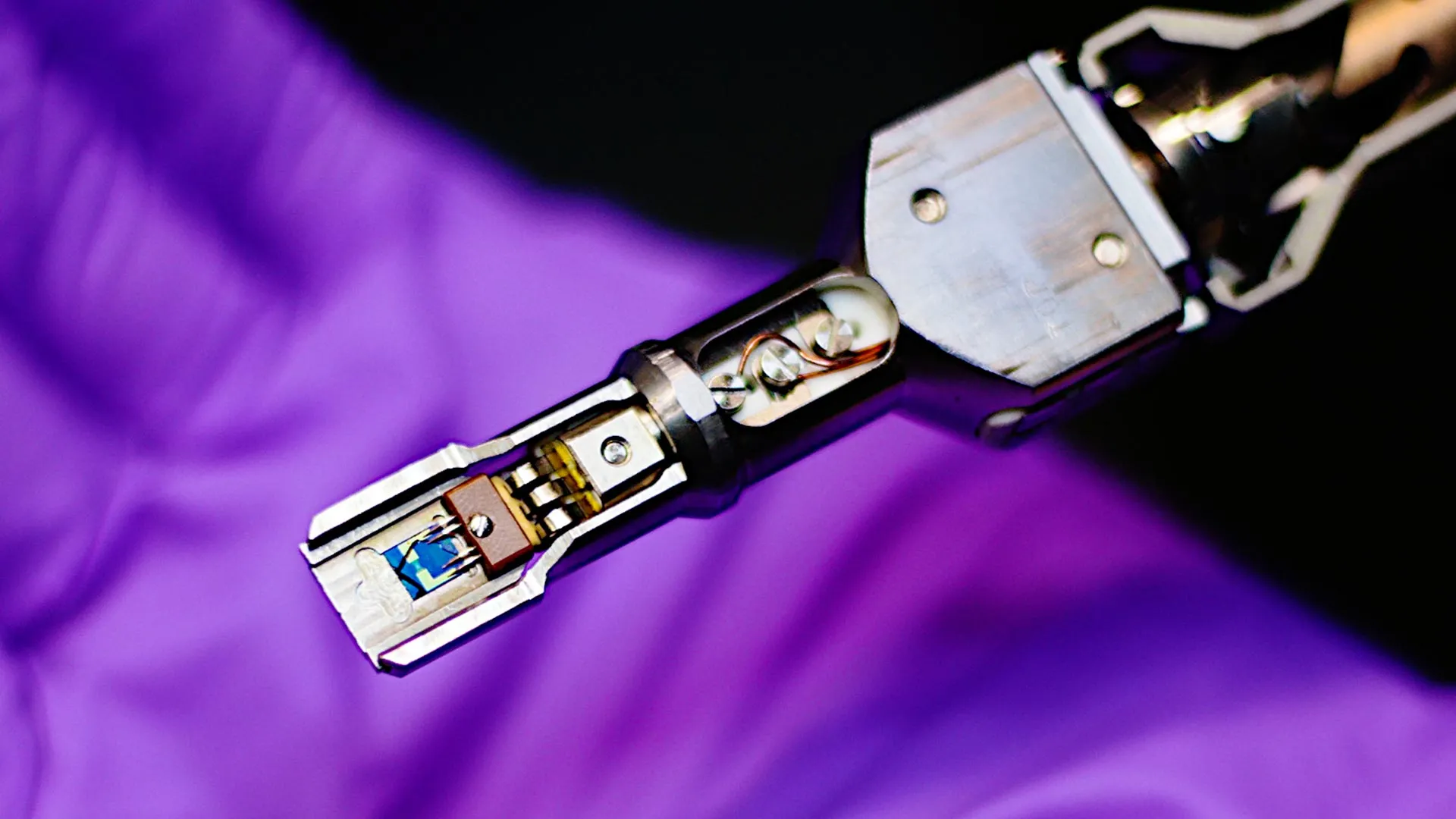
The team then used a scanning transmission electron microscope (STEM) equipped with a heating holder to gradually raise the temperature of the sample above 1100 °C. This setup made it possible to record the melting process in real time and at atomic resolution.
How AI Made Atomic-Scale Tracking Possible
Tracking the motion of individual atoms during melting produces an enormous amount of data. According to Kimmo Mustonen from the University of Vienna, senior author of the study, this task would not have been possible without artificial intelligence. "Without the use of AI tools such as neural networks, it would have been impossible to track all these individual atoms," he explains.
The researchers trained their neural network using large sets of simulated data. Once trained, the system analyzed thousands of high-resolution microscope images generated during the experiment.
A Narrow Temperature Window Reveals the Hexatic Phase
The analysis uncovered a striking result. Within a small temperature range - approximately 25 °C below the melting point of AgI - the crystal entered a clearly defined hexatic phase. Additional electron diffraction measurements confirmed this behavior, providing strong evidence that this intermediate state exists in atomically thin, strongly bonded materials.
Rethinking How Melting Works in Two Dimensions
The study also revealed behavior that challenges existing theory. Earlier models suggested that both transitions, from solid to hexatic and from hexatic to liquid, should occur gradually. Instead, the researchers found that only the first transition followed this pattern.
While the shift from solid to hexatic unfolded smoothly, the change from hexatic to liquid happened suddenly, much like ice turning into water. "This suggests that melting in covalent two-dimensional crystals is far more complex than previously thought," says David Lamprecht from the University of Vienna and the Vienna University of Technology (TU Wien), one of the main authors of the study alongside Thuy An Bui, also from the University of Vienna.
Opening New Paths in Materials Science
The discovery challenges decades of theoretical assumptions and opens new directions for studying matter at the smallest scales. Jani Kotakoski, head of the research group at the University of Vienna, highlights the importance of the work, saying, "Kimmo and his colleagues have once again demonstrated how powerful atomic-resolution microscopy can be."
Beyond improving our understanding of melting in two dimensions, the study also shows how advanced microscopy and artificial intelligence can work together to explore new frontiers in materials science.
Key Takeaways
- When materials are only a few atoms thick, they do not melt in the usual way. Instead of jumping straight from solid to liquid, they pass through a rare intermediate state called the 'hexatic phase'. Scientists at the University of Vienna have now observed this process directly for the first time in atomically thin crystals of silver iodide (AgI).
- To make this possible, the researchers sealed a single layer of silver iodide inside a protective 'graphene sandwich'. Advanced electron microscopy and neural networks were then used to track how individual atoms moved as the crystal heated and began to melt.
- This approach revealed a clear result. Within a very narrow temperature range, about 25 °C below the melting point of AgI, the crystal entered a distinct hexatic phase that exists between solid and liquid.
- The team also uncovered an unexpected twist. While the change from solid to hexatic happened gradually, just as theory predicted, the final transition from hexatic to liquid occurred suddenly, similar to ice melting into water. This contradicts long-standing assumptions about how two-dimensional materials should melt.
- Together, these findings reshape scientists' understanding of phase transitions in real materials and provide a stronger foundation for future advances in materials science, especially at the atomic scale.
Story Source:
Materials provided by University of Vienna. Note: Content may be edited for style and length.
Journal Reference:
- Thuy An Bui, David Lamprecht, Jacob Madsen, Marcin Kurpas, Peter Kotrusz, Alexander Markevich, Clemens Mangler, Jani Kotakoski, Lado Filipovic, Jannik C. Meyer, Timothy J. Pennycook, Viera Skákalová, Kimmo Mustonen. Hexatic phase in covalent two-dimensional silver iodide. Science, 2025; 390 (6777): 1033 DOI: 10.1126/science.adv7915
Cite This Page: